The TRAP Trial Begins with the Lifting of a Magic Latch (Part 5 of Ms Lab Rat’s Latest NIH Adventure)

At the close of my most recent installment of my chronicle of a Day-In-The-Life of an NIH Lab Rat, I was about to enter the phlebotomist’s cubby.
You notice I then abandoned the narrative for blog posts about light subjects such as breakfast and…biopsies. Needles. I just can’t get around them.
Gentle Reader, I am not so fond of needles. You would think, after over twenty years of self-injecting medications—once a month for Zinbryta, once a week for Avonex, once a day for Copaxone—I would be jaded by now. I am not. I squirm when I see an injection on TV. (For me, the most memorable moment of the very memorable movie Traffic occurred when the daughter of the anti-drug Czar smiles drowsily as she shoots drugs through a needle into her arm. I have yet to smile drowsily while injecting. It’s a goal.)
As I took a seat in the phlebotomist’s chair, I couldn’t help but notice a thank you note strategically posted across from the hot seat. Had I been a strategic blogger, I would have taken a picture of the note so it could later serve as the featured image of this post. But that’s not the person I am, nor the person I want to be. There was a brief period of time when I used to collect experiences for my blog. Once I realized I was collecting experiences instead of experiencing experiences, I backed off. So that’s my excuse for why there is no photo of the thank you note, or even a transcript of it. I can only offer you a paraphrase. The note went something like this:

Dear Mr. So-and-So,
Our son has undergone intolerable challenges. Somehow you managed to make the whole ordeal fun for him, and we can’t thank you enough for being a light in this very dark time.
With gratitude,
Mom and Dad of a Very Sick Vulnerable Boy

This note comforted the hell out of me. And put me on notice that I’d better not be wimpier than the Very Sick Vulnerable Boy.
By this point in my fairly vast experience with a wide variety of phlebotomists, I’ve learned that most are ordinary people, whose needles puncture flesh. But there are a few phlebotomists—a select few—whose needles create the sensation, not of a puncture, but of a lifting of a magic latch. So far, the phlebotomists I’ve encountered at the NIH fall into this latter category of elite magicians.
I did not ask this fellow to tell me more about this note he had on display. I’ve found, the hard way, that it’s best not to get personal with a health care technician when they are about to get to work. One time I asked a nurse, How was your weekend—a
seemingly innocuous question—and tears sprang to her eyes. The next thing I knew, she was telling me how her little boy had been out riding his bicycle right on their block when he got hit by a car. She then connected electrodes to the wrong place on my foot, and I endured 15 minutes of non-therapeutic electric shocks. Served me right.
So no, I did not ask this phlebotomist to tell me more about the little boy in the note. I was rewarded for my reticence. He told me—they all tell me—that I have good veins. And then he magically extracted blood from those veins, without my feeling a puncture, but rather, a lifting of a magic latch.

Go back

Your message has been sent

Warning
Warning
Warning
Warning

Warning.

Enter your email address to subscribe to this blog and receive notifications of new posts by email.

MS Blog with Boob Pic

Ms. Lab Rat is supposed to be a blog about an intrepid gal who joins clinical trial after clinical trial, surfing on the cutting edge of multiple sclerosis research.
Ms. Lab Rat is not supposed to be a blog about an anxious gal whose left breast is on the cutting edge of a surgical scalpel. But that’s where this MS blogger will be, while The Art Academy is closed for Spring Break.
Sorry.
(I know, I know, I shouldn’t be the one saying sorry. But have you have ever met a person who did not apologize for a physical misfortune beyond their control, be it mild hearing loss, Sorry, could you repeat that?—to terminal cancer, I’m so sorry I won’t live to see my baby graduate high school. You want to say: I’m the one who’s sorry.)
In this case, Gentle Reader, you needn’t be sorry for Ms. Lab Rat—yet. I have health insurance. (Thanks, husband.) I have a support system in place. (Thanks husband/family/friends.) And I don’t have cancer. (As far as the pathologists can tell.)
What I do have are a few cells that kind of look like they could turn into cancer…or look like the type of cells that tend to hang out with cancer cells. The pathologists couldn’t really agree on what to make of these suspicious cells. Which was why it took them a week, and not the promised one to three days, to call me.
As it happened, I got this call just two hours after I’d learned I have severe osteoporosis, and just a half an hour before I was scheduled to teach Artist as Reader. I was in the middle of an enormous copy job, which involved making 17 two-sided copies of the 92 page screenplay of Get Out. The call made me laugh. Two bad health updates in two hours? Who gets that? It seemed too bad to be true. My biggest fear remained the complicated copy job. I really really hate copier jams, especially so close to class time. Trivial frustrations like that are somehow harder for me to take then even super grim news. The printer didn’t jam. I was genuinely relieved, and genuinely curious to see what my students would think of the manuscript. I couldn’t be bothered to update my blog post about my osteoporosis diagnosis with a dramatic PS. I had a class to teach. Besides, my mom reads my blog. (Hi, Mom!) I didn’t want to worry her.
I am now scheduled for a third biopsy, a surgical excision that will scoop out the entire perplexing nodule and resolve any unanswered question. I’ll be glad to be rid of the uncertainty. I’m not yet skilled at living with anxiety. Last night, I had a hard time getting back to sleep after my 4th or 5th fourth trip to the bathroom (thank you, MS bladder.) I tried meditation after meditation, but stayed awake from 2am to almost 4. (I fell asleep just fine after trips seven and six.) OK, maybe it’s time to botox the old bladder again. Do you see how living with MS is in itself a full time job?
I was grateful to have yoga today, to help me unwind and expand, physically and mentally. As I had hoped, I was not the only student at this week’s class for yoga with MS and Parkinson’s. I met two intelligent, ambitious women there, an accomplished artist and an accomplished writer, and best of all, I got to catch up with my buddy Monica. We lingered over our Wahls-compliant lunches to chat about breast biopsies, and so much more. In a few short weeks, we’ll have matching scars.
It seems no MS story is as simple as just one diagnosis. At least, not for those of us lucky enough to be living decades with MS—long enough to encounter the usual trials of mere aging. Maybe Ms. Lab Rat is a typical MS blog, after all.

Go back

Your message has been sent

Warning
Warning
Warning
Warning

Warning.

Enter your email address to subscribe to this blog and receive notifications of new posts by email.

The Yoga Groove

welcome

My long time yoga teacher, Sharon Byrnes, just started two new classes for people with MS and Parkinson’s at her studio, The Yoga Groove. Today I was lucky enough to have a one-on-one with her, so I got to call all the shots.

My body has given me a pretty long to-do list. I’ve been wanting to take a class on how to fall since learning that I have severe osteoporosis. (I was so eager, in fact, that I showed up one month early to  “Free from Falls,” a class which will be offered by the MS Society starting March 6.)

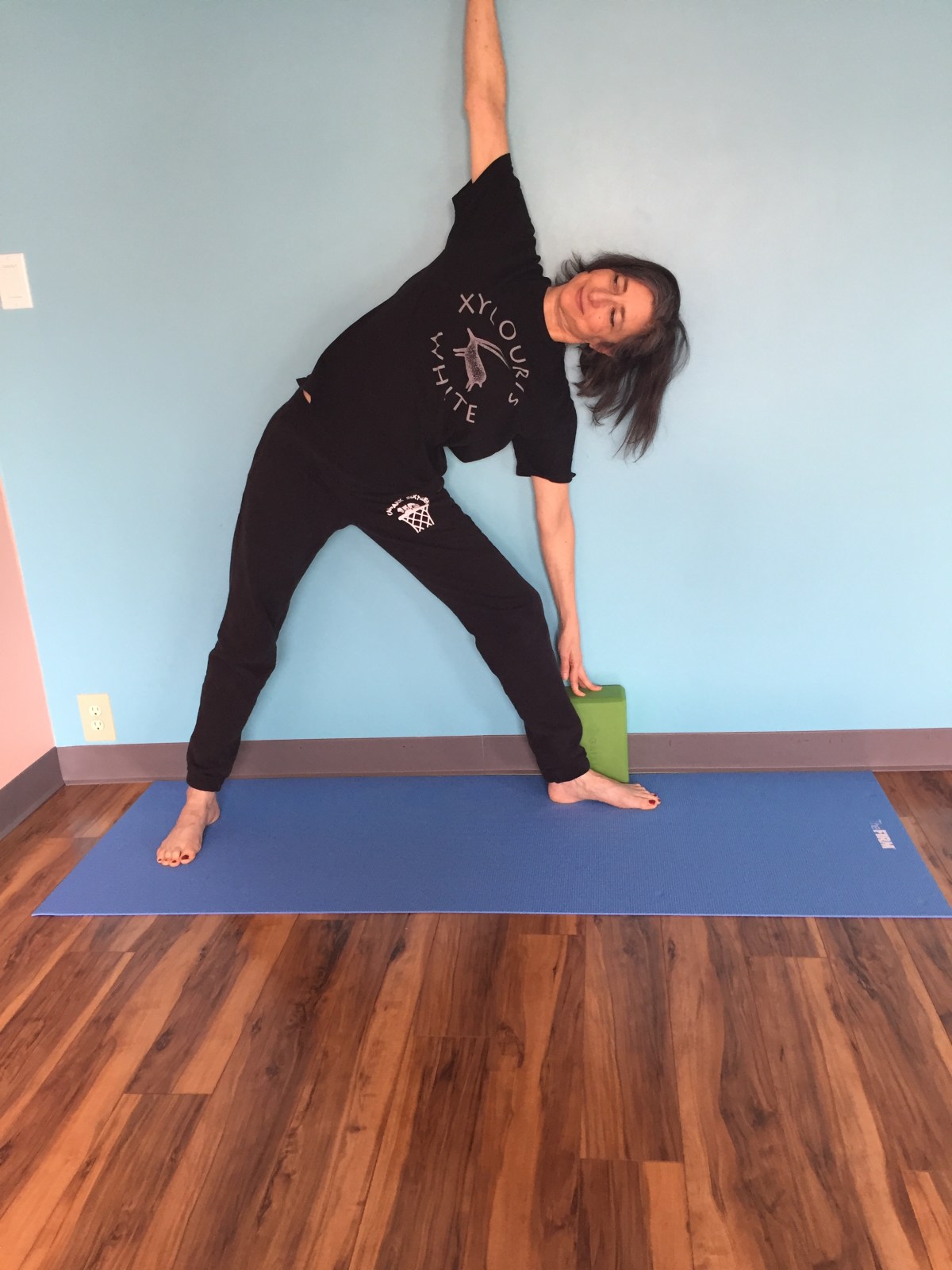
I requested we work on fall prevention. Sharon started me working on transitioning through various yoga poses from against the wall, instead of from in the middle of the room, so that I could use the data from the wall to keep my shoulders, back and hips in alignment while moving from two feet to one foot and back down again. She gave me blocks, so I could safely extend my body and achieve more from each pose.

IMG_9420

foot drop

You will notice, in the second picture, that my foot droops down. Ideally, my foot and leg should be parallel to the floor. Ha. Ha. I know this is the Internet, but I’m still going to show it like it is. What you’re looking at is called foot drop. It’s an MS thing. When I’m tired, like I was this morning after treadmill and weights, I have to use extra effort to lift my right foot off the floor as I walk (or do yoga.) Foot drop has been a big culprit in limiting my walking. Until I got hand controls,  it even limited my driving.

I asked Sharon about foot drop. I’d seen what looked like a helpful video on YouTube…but I wanted to verify that the advice it gave was any good. Sharon watched me demonstrate what I’d remembered of the video, which entailed sitting in a chair, raising the foot, swiveling it in one direction over seven seconds, and then back in the other direction seven seconds…to be repeated over three minutes. She immediately made three suggestions: 1. to keep my ankles in line under my knees (I should know that by now!)  2. to use a resistance band (I tend to be lazy about adding props.) 3. to work out both ankles, not just the one that gives me trouble,  working right/left/right instead of working the right ankle exclusively.  Her suggestions affirmed what I have learned throughout the years: YouTube is no replacement for first hand experience from an experienced instructor.

She then got out a timer and had me tap my foot. I produced 28 taps in a minute, which was less than her 48, but not as far from the 32 taps per minute I should have for a goal.

After our session, I immediately texted my friend Monica, who is off having a grand time in New Orleans this week and couldn’t attend class. She wanted to know all about how to prevent foot drop. As Sharon remarked on my way out, students learn a lot from their teacher, but learn even more from each other. My one-on-one with Sharon was amazing, but I can’t wait for next week, when my peers will be there, too.

Go back

Your message has been sent

Warning
Warning
Warning
Warning

Warning.

Enter your email address to subscribe to this blog and receive notifications of new posts by email.

Everyone Is Doing the Best They Can

The main perk of teaching is that I get to learn a lot from my students, who range in age from 18 to 96 years old. Last semester, one of my students on the younger end of that spectrum said something so profound, I’ve wound up repeating it to myself every day.  “Everyone is doing the best that they can.”

When I was that student’s age, I’d had the opposite response to those around me. I’d always been quick to call out posers, slackers and fools.

As the humiliations of my disease pile on, I find myself doing  many of the very things I’d formerly found inexplicable and utterly ridiculous. And that’s on a good day.

Take the treadmill. I’d never understood the point of it. As a writer, I’m fond of forward motion. You can’t do better than climbing a mountain to learn everything you need to know about a narrative arc. You can’t have a hero’s journey without setting off toward the unknown, somewhere beyond the horizon, preferably on foot, or at the oar. What self-respecting writer could prefer the tedium of walking or running indoors to the nonstop novelty of walking or running in the wild? Only a coward, or a terminal bore.

When my doctor discovered my bones are two standard deviations more breakable than the bones of a typical woman my age, she recommended I quit swimming — which she’d formerly lauded as the best form exercise — and instead try out the treadmill. She explained that I would have to submit to gravity if I were to ever have a chance at rebuilding my bones.

This is how low I have sunk: so far, the switch to the treadmill has been an adventure. My first day on it, I was grinning like a ninny at the novelty of elevating my heart rate. (Thanks to MS, I am confined to doing exercises at a rate that doesn’t raise my body heat: once the heat is on, the wiring in my brain blows out.) I only made it through five minutes. (And those last 35 seconds took some discipline.) I then tottered 15 feet to the ring of machines I’m familiar with—my toys!—and returned to my weight routine—low settings only, because strain could pop my retina. (Is this silly, or what?) I have since worked my way up to six minutes per treadmill session. And then I had my breast biopsy. I’d been planning to drive to the gym afterwards. Instead I was told to stay out of the pool (again?) and not lift anything over five pounds for that day. Theoretically, I could have driven to the gym for maybe six and a half minutes of treadmill, and the leg machines. Ha ha.  Instead, I opted to heal.

So yes, today, Gentle Reader, if you see a woman on the treadmill, she isn’t me. I ask you to see her as my student would see her. I ask you to assume that the woman on the treadmill is doing the best that she can.

Stay healthy!

Go back

Your message has been sent

Warning
Warning
Warning
Warning

Warning.

Enter your email address to subscribe to this blog and receive notifications of new posts by email.

IMG_3573

We Interrupt this Narrative

I’ve been meaning to construct a nice, orderly narrative of my most recent visit to the NIH, one that didn’t jump around in time too much, but I’m going to interrupt this account at the point right before I meet my phlebotomist—Who wouldn’t want to delay getting pricked?—by announcing I have just now learned I have a new diagnosis—severe osteoporosis. Which I never would have tested for had I not joined this latest NIH study, which recommended a dexa scan.

I can’t afford to get too worked up about this. I’ve got an hour until I leave for my first day of teaching Artist as Reader. I know half my students from previous classes, and they give me great hope for the future. We are going to make art in response to the screenplay of Get Out, my current favorite move, The Sympathizer, my current favorite novel, and Don’t Call Us Dead, my current favorite poetry collection.

Don’t call Ms. Lab Rat dead. Osteoporosis is just another bump in an admittedly bumpy road. If I hadn’t been ordered to take a bone scan, I certainly wouldn’t have. And I wouldn’t have learned a kind of important new feature of my ever changing body. 

Go back

Your message has been sent

Warning
Warning
Warning
Warning

Warning.

Enter your email address to subscribe to this blog and receive notifications of new posts by email.

Breakfast Break: MS Style (part 4 of Ms. Lab Rat’s Latest NIH Adventure)

When we last left off, I, Ms. Lab Rat, was sniffing the sickly scent of powdered sugar as I passed the by-now stale gingerbread houses on display in the secular cathedral that is the NIH (National Institutes of Health.) I had time to kill before my Phlebotomy appointment, so I took the elevator to the second floor cafeteria, which has an excellent salad bar. And discovered I was too early for salad.

Here’s the deal with my new Wahls-inspired MS diet: the foods I used to associate with breakfast are off the menu. No processed foods, no gluten, no grains, no milk (bye bye breakfast cereals,) no eggs, no cheese (bye bye omelets.)

Here is a picture of what breakfast looked like for me today: IMG_9271

You’re looking at bok choy and garlic escargot simmered in homemade chicken broth, topped with kimchi and dulce. The Wahls Diet calls for the consumption of four servings of leafy green veggies a day, at least four servings of colorful fruits and veggies, a meat, a touch of seaweed, a bit of something pickled. The Wahls Diet is also very very big on homemade bone broth. So this breakfast covers pretty much all the bases. (If I were a true purest, there would have been a little knob of organ meat floating around in the bowl, too. But that’s the thing about the Wahls diet. Or maybe any diet? You can always feel you’re not quite up to par.) This breakfast was yummy, by the way. But this kind of breakfast is not easily obtained on the road. Not even in a hospital. (By the way, what’s up with hospital food? Why are there so many unhealthy choices? Topic for another blog.)

Here’s a fuller, indeed cluttered picture of what breakfast looked like for me today, when I tell the whole complicated story of my MS maintenance:

IMG_9272

You are still looking at my pretty bowl of healthier-than-thou breakfast food. You are also looking at the supplements required for the clinical trial of the Wahls Diet:

5,000 IU Vitamin D3, 1 t cod liver oil, 5000 liquid vitamin B12, 1 mg folate, multi-vitamin.

Then there’s all the stuff I have to take for my funny bladder:

AZO, macrobid, and some other antibiotic I’ll be finished with at dinner.

Then all the stuff I choose to take for my self-designed Ms Lab Rat trial:

3x 100 mg Biotin (which I am hoping will eventually fix my bladder problems and get rid of three of the items above), 500 mg Hemp oil, local hemp oil, glorious hemp oil (which has helped me sleep and dream after many sleepscarce, dreamless years), 5 mg Lithium (which I thought was doing a fine job as a mood stabilizer, though I just learned that what I take isn’t anything like a mood stabilizing dose. So let’s call it my placebo.)

This is a lot to keep track of. When I graduated from the Swank Vs. Wahls clinical trial, I got a certificate (no joke) and a private viewing of a 20 minute video of Dr. Wahls that just served to delay the seven hour drive ahead of me. No t-shirt. The only remotely useful thing I left with was a booklet to help me keep up with all the details of living in a Wahls Diet world. (I had rallied hard for an app, but there isn’t one. Yet.)  For a few weeks afterward, I kept filling in little circles every time I popped another supplement, or finished another serving of leafy greens. But eventually I ditched the booklet. I want to feel a little less obsessive, a little less persnickety. Either that, or I’d already assimilated all the expectations. My brain had become the diet app I’d been asking for.

The morning of my TRAP trial, I realized I was not going to get a Wahls breakfast, or Wahls-ish breakfast before my blood draw. I guzzled a “green” drink I purchased from a vending machine and took the elevator down to Phlebotomy. A lovely woman handed me a white stub with a number. As I glanced down to read 32, she called, “Thirty two.” It was the Christmas holiday. I was the only patient in the waiting room. I filed past untouched trays of cookies and two pots of coffee and entered the orderly hive of numbered white cubicles, wondering if I’d recognize my phlebotomist. I had been there many times before.

Go back

Your message has been sent

Warning
Warning
Warning
Warning

Warning.

Enter your email address to subscribe to this blog and receive notifications of new posts by email.

TRAP (part 2 of Ms. Lab Rat’s Latest NIH adventure)

The vast lobby of Building 10 of the NIH was nearly vacant of the usual international mix of medical professionals and imperiled pilgrims, yet it felt cluttered. This majestic bastion of scientific research had been stuffed with numbered tables bearing garish gingerbread houses, presumably made by the in-patients and staff. It looked like a pop-up church raffle. I glanced past the hapless man marooned at the Welcome Desk and noted that the coffee shop was now barricaded by scaffolding. The scent of coffee had been replaced with insidious notes of powdered white sugar. I wondered if perhaps my system of always accepting the first appointment of a given span of available dates would finally let me down. We were three days out from Christmas. The speculation on the van was that the leading physicians would still be on vacation. I didn’t buy into that. I expected to see leading physicians. Then again, I’d also expected coffee.

I ducked into the area on my right to fill out the paperwork for meal reimbursements. Over the years, the reimbursement office has retained the right to perpetuate various iterations of needlessly awkward exchanges. The first few years I’d gone there, the cashier’s desk was an inch or two too deep for the cashier to actually reach the exchange window to grasp a lab rat’s ID or to pass a lab rat some cash. It added a bit of tension, a bit of comedy, to every exchange. After a few years of these capers, the cashier figured out she could use a pincer device to bridge the troublesome gap. Her victory was short lived. By my next visit, the entire office was moved. By the visit after, the “short-armed” cashier was gone.

The tradition of inventive obstructions was still in full force, I noticed. There was a sign in front of the office that receives reimbursement forms which instructed all form fillers to stand at a certain distance in front of the glass door, and further warned that those who did not stand would not be seen. In other words, Wheelchair Users, Begone.

Furthermore, the very layout of the office was designed to prevent eye contact, even with compliantly standing non-wheelchair users. The L-shaped desk for the sole employee in the office was set back and to the side of the glass door. The computer was placed along a wall at a ninety degree angle from the door, so that the occupant of the office effectively had her back to the door every time she looked at her computer. Once again, the office had been created to make it structurally impossible for the employee to do her job effectively.

I wish I could say this office is an anomaly in the NIH. It is not. There are doors in the MS clinic without wheelchair accommodation. If that’s the NIH plan to stop MS progression…it isn’t working yet.

The only other pilgrim there was a man sprawled out on a chair. Had he been conscious, I would have asked him if he needed me to signal to the functionary behind the glass door. Instead, I waited for the functionary to complete her personal phone call, then check her computer screen, then finally swivel somewhat to notice me standing the appropriate distance from the glass door, like a good wheelchair-free pilgrim.

She waved me in.

I used to feel unworthy of meal reimbursements. But that was before the drug the NIH tested on me came out on the market, and my monthly deliveries came with an invoice of seven thousand four hundred and something dollars per month.

I handed in my clipboard, feeling entitled to every last penny, darn it, and headed for my appointment at Phlebotomy.

The acronym for this new study? TRAP.

Go back

Your message has been sent

Warning
Warning
Warning
Warning

Warning.

Enter your email address to subscribe to this blog and receive notifications of new posts by email.

Addicted to Trials (Part 1 of Ms. Lab Rat’s Latest NIH Adventure)

My name is Ms. Lab Rat. I have multiple sclerosis. I am addicted to clinical trials.

It had been 32 days since I’d finished my last clinical trial in Iowa City when I slipped out of a white van on a cold December morning and surrendered my coat and my purse to the jocular security crew at The National Institutes of Health in Baltimore, Maryland. When asked by a cheerful ex-navy, “Have you been here before?” I had to smile back. I’m terrible with numbers, but by my feeble estimation, I’d been to the NIH 44 times before: once a month for three years during the trial for Zinbryta, once every six months for the three years it took for the FDA to approve Zinbryta, plus twice for initial trial visits. Gentle reader, chances are your brain is less riddled with lesions than mine. You do the math. Numbers aside, I think we can all agree; I’ve been a regular.

Back when I started the Zinbryta trial, when the drug was still fairly new to me, my life had been much more limited by my disease. I was a regular at my drug store, a regular at the places I volunteered. No one paid me to hang around. Zinbryta stopped the raging inflammation that had peppered my brain with lesions. My relapsing remitting multiple sclerosis stopped feeling so…unremitting. And gradually, I was able to get small but super-meaningful jobs. First I was hired to host creative writing sessions with a uniquely brilliant group living at an upscale assisted living center. I am in awe of the supportive creative community we have maintained. Then I was hired to teach writing classes to radical, relentless, radiant young artists at a celebrated arts college downtown. The younger generation fills me with hope for a more just, more equitable, more dazzling future. Through the years, I have maintained the same prolific community writing workshop. We all publish. Some of us publish quite a lot. Zinbryta has allowed me to expand my identity beyond MS patient, to teacher. When the security guard handed me my one-day NIH ID, you’d better believe I thanked her.

I hopped back into the white van with a couple from Georgia. The husband had spent the trip describing the career he’d had to abandon. “I want to get back to work, do what I can from a wheelchair. But first I’ve got to get this cancer under control.”

I could relate to his frustration. I could relate to his hope. Zinbryta has helped rein in my MS. It’s been necessary. But it hasn’t been sufficient. When we reached good old Building 10, I hopped out of the van. I was eager to get my MS under control.

Go back

Your message has been sent

Warning
Warning
Warning
Warning

Warning.

Enter your email address to subscribe to this blog and receive notifications of new posts by email.

An Open Fan Letter to Roxane Gay

Since hearing an interview with Roxane Gay on Fresh Air, I have been obsessed with watching or listening to every interview with her that I can find. Her point of view is refreshing and relaxing because she’s not trying to be an example to anyone. She’s just trying to be herself in a body that many in society dismiss at a glance. As a person in a disabled body, I can relate. Nobody cares about disabled people. That point was driven home just yesterday, when Capitol police dragged protesters out of their wheelchairs to jai.

Roxane Gay is a model to me, because she does a better job than I do of giving an honest portrayal of what it is like to live in a body that is not sanctioned by society. As she said to  Trevor Noah,  “I wanted to tell the story of my body, because when you’re fat in the world, people have assumptions….I think it is important to show what it is like to live in this world in a fat body.”

When I replace the word “fat” with the word “disabled’ I see we have the same goal. I am further from my goal than she is from hers. Her achievement shines light on where I need to go.

I am always trying to make my site accessible to people who can’t imagine what it’s like to have MS. I want to be that example of a person trying her hardest every day to overcome. But I’m afraid that in my quest to be a create a palatable persona, I might be neglecting the complexities of living with MS, a debilitating illness that has no cure.

For instance, I was very eager to post the image of myself zip-lining down a volcano in Costa Rica. That moment was a dream come true for me. I’m a person who has a hard time walking. Why wouldn’t I want to fly?

I felt chastened, though, when I came home and someone told me, “I have to show that picture to my son with MS. He would never zipline!”

I hate the idea of my blog existing as a rebuke to people with MS who don’t have the financial resources or the supportive spouse that make my adventures possible. I know what team I’m on. I also know what team would never choose me. (I’m looking at you, Mitch McConnell.)

I’ve been thinking about the images I share on this blog, and on Twitter. My profile picture on Twitter is of me in mid-jump. You might think from this image that I’m a super-athlete. In a way, I am. But that’s just because moving anywhere near normally is a lot harder for me than it is for the able-bodied. My legs can feel very heavy to me, because I can’t control them terribly well. If you’ve ever had to move a full-grown human being whose body is not attached to your central nervous system, you might get the idea. I can be dead weight to myself. So yeah, I often do feel a great deal of accomplishment by merely crossing a room. The closer I get to appearing to move normally, the more I feel I’ve gotten away with something. But this is what I fear: by aping normalcy, I am rejecting the very people whose daily experience I actually share.  Today I am posting a picture of myself not flying, not jumping, but squatting, as I take a break during a jungle hike. You will notice I used walking poles. I myself want more images of people using walking poles out here in cyber-space, so that people like me, who need them, can feel more comfortable about using them to go a little further in this world.

I am very eager to read all of Roxane Gay’s books. I am also eager to try harder to be true to my own experience, which isn’t all transcendence. Let me know when I fall short.

Enter your email address to subscribe to this blog and receive notifications of new posts by email.


What’s Wrong With This Picture?

Bad Decision

Yesterday my friend Monica and I went kayaking on the Miami River. When you read, “kayaking,” you might get the impression we were paddling madly. We were not. We were just two women of a certain age, bobbing along on a still lake, dipping our paddles occasionally as we chatted.

Monica and I met at a yoga class for people with MS. We’ve both had MS symptoms for decades. We share the same neurologist, Dr. Z. MS gives us a lot to talk about. I told Monica how much I admired her decision to stay away from MS medications, despite Dr. Z’s recommendation to start one. I think she’s been managing her disease really well. Monica runs her own business. She can hike for miles. She can drive without hand controls. She can put on a sneaker while standing on one foot. If I could do those things, I’d consider myself pretty well cured.

Monica told me she admires me for being brave enough to try experimental medications. I assured her I haven’t been brave, only desperate.

I would be oversimplifying to present us as taking opposite tacks. If you were to draw a Venn diagram of our approaches to MS, you’d find a pretty big overlap in the center. We both do yoga. We both experiment with controlling MS through diet; me in a clinical trial, and Monica in the privacy of her own kitchen. We are both total strivers, still hoping to get healthier, not sicker, as though we weren’t aware we have a degenerative disease. What’s our secret? Delusion, we agreed, laughing. Every day, we push forward, not necessarily ignoring the bad stuff, but not letting that stuff define us either.

When I observed that we’d been under the sun for a while, we paddled over to a shady spot, being the proactive types who wouldn’t ignore the sun and overheat, thereby triggering our MS symptoms.

Monica took a picture of me in my rented kayak, wisely sheltering beneath an overhanging tree. I’d made a good decision, right? Nope. I’d made a bad decision. This morning I’d woken up itching.  Turns out, I’d been nestled in poison oak. I’m not saying I would have been better off heating up in the middle of the lake. But maybe I should have chosen to not shelter quite so deeply in the shade.

Here’s the thing about living with MS in these times: there are many treatment options to choose from, including the option to not medicate. Smart, conscientious people can labor over these options for days, or even years, yet make a choice with grim consequences. When I was a little kid, I used to think I’d eventually recognize the bad option when I saw one. Boy, did I underestimate the complications of this world.