Power Outage

Six days and six hours after Hurricane Irene blew out the power, a friend in Connecticut finally got her electricity back. She posted on Facebook that she’d started the dishwasher and the washing machine. She wrote: “I have to say it wasn’t entirely a negative experience. I’m actually happy to have experienced it.”
I have a hunch I know what she means. I’ve lived through a few power outages. They transform the humdrum household into an exotic locale, where previously automatic tasks require improvised solutions. With every reflexive, futile flip of a light switch, we are reminded of how much we ordinarily take for granted. We feel entitled to our electricity, darn it. And then we adjust. Instead of cursing the darkness, we light candles. We grill all the meat. We gather together. We entertain each other. We tell stories. We sleep deeply. The remaining food rots. The dirty clothes pile up. We understand the power company is working tirelessly to fix the problem. We wish they’d hurry the hell up. We understand it is useless to complain. We complain. We wish everyone else would quit complaining— we’re all in the same boat. We’re all in the same boat—and that’s kind of cozy. The power comes back again. We are oh so grateful for a good five to ten seconds. Then we scatter—one to load the washing machine, one to buy the milk, one to download distractions. Normal life resumes, with all its quotidian conveniences and isolations.
An attack of multiple sclerosis is also a power outage. The brain blows another fuse, and a function is lost, maybe for a few days, maybe for forever. A previously automatic task requires an improvised solution. I feel entitled to cross a room on my own two legs, darn it. And then I ask for assistance. I take my husband’s arm. My son pushes the wheelchair. The family draws closer together. We see ourselves as problem solvers. We wonder when the power will come back. We understand the pharmaceutical companies are working tirelessly to fix the problem. We wish they’d hurry the hell up. We understand it is useless to complain—we don’t know anyone in the same boat. We prepare ourselves to live this way forever. “This way” doesn’t stay this way for long. It gets better. We are oh so grateful. Or it gets worse. We adjust.
We never take my relative health for granted. No one understands the vast complexity of the central nervous system better than a person whose central nervous system is constantly on the fritz. The basement fuse box presents a laughably simplified metaphor. We are only dimly aware of the multitude of problems that could yet occur, and we are fully aware that such ignorance is bliss.
After our last multi-day power outage, I proposed that maybe our family could consider off-the-grid Sundays. By off-the-grid, I envisioned something sort of fuzzy and candlelit, nothing as hard-core as an unplugged refrigerator, although an unplugged stove, and the consequent necessity for Thai take-out, seemed perfectly reasonable to me. Needless to say, I was met with immediate opposition.
There’s no need to opt for hardship. Hardship will come to us. It’s too bad we can’t fully rejoice with every flip of an operative light switch, or with every synaptic leap in our central nervous system. But we can’t. If MS relapses have any benefit at all, it’s that I keep getting new chances to recover, whether fully or partly. I get to be aware of the health I’ve still got. It’s not often that I’m not in pain. I know, then, to celebrate its absence.

← Back

Thank you for your response. ✨

Enter your email address to subscribe to this blog and receive notifications of new posts by email.

Ask About Your Medication

Note from the Rat: The medication I refer to as “daclizumab” back in 2011 is expected to be marketed to the public as “Zinbryta.”

It is good to ask questions. Even when the answers aren’t always pleasant—especially when the answers aren’t pleasant.
No one likes to ask questions when things are going well. My first months on daclizumab went really well, so I didn’t bother to ask my nurse about the origin of the clear liquid dripping down the IV tube into my veins. Whatever it was, it was working. My multiple sclerosis symptoms were fading into the background. I couldn’t ask for more than that.
So I didn’t.
Month after month, I had the same nurse arrive at my home for infusions. We took to chatting. The heparin scandal came along, taking the lives of 81 Americans who had assumed—as I’d assumed—that nothing fatal could be lurking in a labeled medication. That month, the nurse told me it wasn’t necessary to flush my veins with heparin. I gave her the go-ahead to use it anyway. I didn’t want to mess with success. Eventually, though, I think we may have agreed to skip the heparin flush. Daclizumab kept on working, either way.
The January 2010 home infusion seemed no different than the others. Neither of us knew it would be our last. As usual, my blood pressure was low, as was my temperature—96.8. As usual, I had no troubling new symptoms to report. The drip itself never took all that long—maybe 15 minutes— and as usual, the nurse and I chatted those minutes away. The nurse mentioned she’d seen me lifting weights at the rec center while she’d been walking the track. I told her it would be OK to interrupt me the next time she saw me there. Neither of us could have guessed there wouldn’t be a next time.
I didn’t start to feel funny until the nurse was gathering her bags to leave. Even then, I didn’t feel funny enough to stop her. My temperature shot up during the interval between the thud of the front door and the clap of the screen door —the screen door hinge is on backward, which makes for a thirty second delay.
I headed straight for the couch, and caught a glimpse out the window of the nurse’s car pulling away. I lay down. Something wasn’t right. At that time in my life, it was unusual for me to lie down while the sun was still shining. I dragged myself off the couch and up the stairs to take my temperature. 98.8.
I wasn’t sure if I should call the nurse. Everybody knows 98.8 is not a fever. But 98.8 was two degrees higher than my temperature of just half an hour before. I was comfortable with that nurse. Even so, I didn’t want her to think I was a big baby. Or a hypochondriac. Or a fool. But then I got to wondering about the contents of that IV bag. Who was to say it wasn’t tainted, like the heparin a while back?
I swallowed my pride. I called the nurse and left a message.
It was a good thing I did.
The high temp resolved itself without any apparent consequence. I felt sheepish when the nurse returned my call that afternoon. But then I heard her news. I quit being sheepish, and shifted into high alert.
Apparently, after listening to my message, she’d called the pharmacist to ask about my drug.
“Guess what he told me? He said I just gave you the last of that medication. It’s been taken off the U.S. market.”
I asked if there’d been another safety scandal. She assured me there had not. “Someone’s bought the entire inventory.”
I wondered aloud, “When was anyone going to tell me?”
The nurse didn’t have an answer for that.
If I hadn’t gotten that little spike on my temperature, I could have easily gone another month without knowing I had to line up a new MS medication. I’d already gone through all the standard MS meds, with no positive results, which was why I was taking an off-label drug in the first place. I didn’t know what I would do without daclizumab. There wasn’t another drug out there I knew of.
There’s a happy ending to this little anecdote.
Yes, it’s true I didn’t get the answer I expected when I asked about my medication. But that unexpected answer motivated me to ask more questions. I managed to track down Bibi Bielekova, the neurologist and researcher who had first put me on daclizumab. She had a new gig at the NIH. I sent her an email on a Saturday, asking for her guidance. She replied almost immediately.
Once again, I didn’t get the answer I expected. Her email contained an offer I couldn’t refuse.
As it turned out, Dr. Bielekova was the one who had gathered all the remaining stock of daclizumab. She’d just negotiated a clinical trial for the next generation of daclizumab, called DAC HYP. She would be switching her patients who’d been on daclizumab long term to this new preparation. She wasn’t sure, but she thought she might have an opening to accommodate one more patient in the trial. My flights would be paid for. Then came the clincher, “The care at NIH, including the drug, is free.”
Now you know how I can afford to make all those trips to DC; I happened to ask the right question of the right person at precisely the right time. I’m going to try to make a habit of that.
My next entry will be a review of the formidable book, Dangerous Doses, written by Katherine Eban, another woman who isn’t afraid to ask questions about medications. The answers she’s uncovered may disturb you. Or they may just motivate you. Dangerous Doses has certainly motivated me. Our drugs are too important to remain a mystery.

Riding the Tide

“Lies are what the world lives on, and those who can face the challenge of the truth and build their lives to accord are finally not many, but the very few.” -Joseph Campbell
When I first went on daclizumab, I was euphoric. After going through six neurologists, and three MS medications, I finally found a brilliant neurologist who had uncovered an off-label medication that appeared to actually work.
My husband remained unmoved. He girded himself for every outcome, including the possibility that the medication would fail.
I shared his neutrality. At first. But then daclizumab surpassed my expectations. I had wanted nothing more than a medication that would prevent further exacerbations. What I got was a medication that did all that and more. Suddenly, I felt…able. I was able to hike and swim and lift weights. So I did. I pushed my suddenly able body to astonishing new limits. I rode the wave. I soared. My husband stood steadfast, like a beacon on the shore. He appreciated my toned body, but he didn’t expect it to last.
Indeed, it didn’t last.
No body lasts.
Love lasts.
Years passed. My physical capabilities became less and less astonishing. I had very much enjoyed becoming super-fit. As my physical parameters kept shrinking, I kept pushing back. It was with great reluctance that I finally learned to stop wanting more of my body than it can deliver.
This week, my hard-won acceptance was put to the test. I would have to also learn to stop wanting more of my medication than it can deliver.
The moment of truth arrived on Tuesday. I finally received the news my husband has been girding against ever since I started taking daclizumab, shortly after Tysabri was pulled from the market in ‘05. In all that time, my MRI’s have always come back with no further lesions. I’ve been lucky.
I’ve kept up on the preliminary results of the daclizumab trials, and while they are impressive, I couldn’t help but notice there hasn’t been a 100% cessation of disease activity across the board. Something had to give.
Now finally, something has.
My latest MRI came back with one enhanced lesion.
Just one little lesion, located in the so-called “silent area.” My local neurologist doesn’t think one lesion would be worth attacking with steroids. (And I must say, I’m relieved.)
The news of the MRI didn’t shock me. It was almost a comfort. I already knew I wasn’t well. It actually felt good to have some confirmation that there was a reason, even if that reason was inconveniently screaming from the “silent area.”
Daclizumab has worked wonders for me. But it is what is. It’s a medication—the best I’ve ever taken. It is not a miracle. It is not a cure.
Daclizumab is fallible. Just like me. That doesn’t mean it’s a failure.
I’m glad I haven’t been afraid to hope. Hope did me no harm, after all. Yes, I was once euphoric, but with good reason. I’d been given a reprieve. When the facts changed, I didn’t break. I changed along with them.
It’s been a good ride.

Made in the USA

Yesterday, I blogged about my discontent with the fact that over 80% of the active ingredients in the drugs we take are being made in far-off places with little or no federal inspection. Until more people know this fact, there is no incentive for change. So here’s my proposal: Every bottle of pills, every IV bag, should list the country of ingredient origin in at least 6 point type. When you buy a carton of orange juice, the carton has to list which country the oranges come from in at least six point type. Why aren’t drugs labeled like food? We ought to expect drug companies to list where their drugs come from. And I’d like those labels to say, in at least six point type: MADE IN THE U.S.A.

Author’s note: Little did I imagine as I was writing this that Merck is pulling up to 13,000 jobs out of the United States and other developed nations to employ workers in “emerging markets.”

← Back

Thank you for your response. ✨

Enter your email address to subscribe to this blog and receive notifications of new posts by email.

I Want Safe Drugs

Yesterday, Big Pharma bankrolled my 7am flight to DC and my subsequent MRI at the NIH. I’ve been feeling wretched, despite the experimental drug I’ve been taking for multiple sclerosis, and I wanted to know why. My return flight arrived six hours late, at 1:30 this morning. A few hours later, I got a call from the NIH. The MRI report is not complete, but so far it shows that I have one new contrasting lesion.
Question: what should I do about this lesion?
It is very likely that a course of IV steroids would zap me back into health. My neurologist claims there’s no long term benefit, but I’ll take a short term benefit if it means I’ll no longer be dizzy and nauseous and fatigued and tingly and struggling with my gait. Besides, in my personal experience, the relapses that I haven’t treated with steroids were the ones that produced the symptoms that persist. I once skipped a round of steroids so I could take a vacation in Maine. The tingling in my fingertips with every tap of the keyboard serves as a suggestion that maybe I should have delayed the trip a couple days.
A course of IV steroids is nothing to take lightly. For one thing, it’s expensive. That’s no problem. We have insurance. We have money. We can afford it.
For another thing, a course of IV steroids is physically and psychologically grueling. I’m likely to get ornery. I’m likely to get hungry. I’m not all that likely to get any sleep. My family and I will have to endure a few days of my feeling like a big fat angry monster. No problem. We’ve survived rounds of steroids before.
We’ve been lucky to survive. Because here’s the real problem: It’s a social, economic, and political matter, and it concerns you, gentle reader, and every person you know who takes or will take a drug.
You may not be aware of this, but the ingredients in our drugs are increasingly manufactured in India and China. What with illness and travel, I’ve been behind the Times, so to speak, and only just now got around to reading Saturday’s front page article, “Deal in Place for Inspecting Foreign Drug Suppliers, A Glimpse at Suppliers in Shadows Abroad.”
Apparently, “More than 80 percent of the active ingredients for drugs sold in the United States are made abroad, mostly in a shadowy network of facilities in China and India that are rarely visited by government inspectors”
This is a problem.
I don’t know where the steroids are coming from. But I do know they are typically flushed with heparin. Does the name “heparin” sound vaguely familiar to you? You might recall the scandal a few years back, when “Chinese manufacturers deliberately substituted a cheap fake for the dried pig intestines used to make the blood-thinning drug heparin. The tainted drug was linked to 81 deaths and exposed tens of thousands of people to danger. The F.D.A. never inspected the plants making the crucial ingredients, a larger problem that only now, more than three years later, may be fixed.”
What if that heparin problem isn’t fixed? Do I unwitting submit to paying for “a cheap fake” coursing through my veins? Or do I not take the drug, and continue to suffer?
Now, the whole purpose of the Times article was to celebrate a “breakthrough” in foreign inspection. There is currently legislation on the table. “The proposed solution to this problem is for generic pharma companies to pay the FDA $299 million/year to send representatives from the FDA all around the world for bi-annual inspections.”
I don’t think too highly of this solution.
There’s one other issue that’s been in the papers lately. Way too many Americans are out of work.
Why not bring the drug manufacturing jobs back to the USA?
Drugs could be more easily inspected. Americans could get back to work again. Patients like me can feel confident that the drugs we are taking will help us, not harm us. Drug companies, generic and non-generic, can avoid further scandal, like the Tylenol debacle that broke out just today.
As a lab rat, I have some inkling of all the care and expense and governmental cooperation that goes into testing a new drug. Why let that work go to waste with a sloppy end product?
I may just use my steroid fueled ornery energy to see what a big fat angry monster can do to get some real change going in the way our drugs are manufactured and inspected. I believe there’s a real opportunity for the first major drug company to tout their drugs as being manufactured and monitored right here in the USA.

← Back

Thank you for your response. ✨

Enter your email address to subscribe to this blog and receive notifications of new posts by email.

Type A

Today a specialist asked me if I had a certain personality.
I may have responded with an arch look.
He rephrased the question. “How would you describe yourself? Your personality? ”
I knew where he was going with that line of questioning. He wanted me to confirm his at-a-glance hypothesis that I am a Type A personality. Apparently The Specialist subscribes to the popular theory that Type A personalities are more prone to autoimmune diseases like multiple sclerosis (MS.)
“Has anyone ever told you that you are a control freak?”
He has nothing to gain from this line of reasoning. Think about it. Of the two of us, who is more likely to have a Type A personality: the guy with the medical degree, or the gal with the MFA?
I countered, “I think that’s just blaming the victim.”
I don’t (necessarily) have a bad personality. I just have a bad disease.
The Specialist kept describing the Type A personality. “Do you set goals for yourself?”
“Sure I do. And maybe I’ll accomplish all of those goals in a day, and maybe I’ll only accomplish only one. Or none at all. My body has the final say.”
“So you’ve reached Acceptance.”
Acceptance. I didn’t know what The Specialist would think about that. Acceptance doesn’t carry much of a cachet among Type A personalities.
I ventured, “I don’t know if that’s good.”
Though of course, I do know that it’s good. In my case, Acceptance is reasonable. All my MRI’s in the past four years have come back showing no new lesions. It’s appropriate to reach Acceptance when you’re on a drug that actually works.
The Specialist was happy to hear about the efficacy of the drug, even though he couldn’t find “daclizumab” or “DAC HYP” on his portable information device. (I probably spelled it all wrong.) He seemed more frustrated that he couldn’t shoehorn my personality into his Type A hypothesis. He kept trying. He listed high achievers who had autoimmune diseases. Montel Williams’ MS. Michael J. Fox’s Parkinsons.
I could think of one other thing these guys had in common, besides autoimmune diseases. “These guys are both celebrities. You kind of have to be a high achiever to become a celebrity.”
Whereas, you absolutely don’t have to be a high achiever to become a patient with MS. It’s just not that simple. I know plenty of high achievers. And most of them are not celebrities. Most of them don’t have an autoimmune disease, either. Nor do they deserve one.
I don’t deserve one, either.
“Do you think you used to have a Type A personality, back before your diagnosis?”
Back before my diagnosis, I’d majored in philosophy. What kind of Type A personality would be stupid enough to major in a thing like that?
The kind of Type A personality who thought English majors weren’t thinking hard enough.
Fine.
Have it your way, Specialist.
He proposed, “Some people think meditation could be helpful for people with multiple sclerosis.”
So now he’s “some people.”
“Meditation could be helpful for anyone.”
Touché.
I’m not making a very good case for my being a Type other than A.
The Specialist is an Ear, Nose, Throat guy.
He finally got around to asking me to stick out my tongue.
“You know, thousands of years of Chinese medicine has taught them to diagnose an entire person with one glimpse of the tongue.”
Diagnose?
Or simplify?
I had my tongue sticking out, so I couldn’t reply. And anyway, I didn’t think of a good comeback until after I left the examining room. Here it is: “For hundreds of years, Gypsies have said they can see a person’s fate with one glimpse of the palm.” You don’t see me rushing out to consult any gypsy. I consulted my half-Chinese husband instead. My half-Chinese husband said my sharp tongue was one of the first qualities he loved about me.
So maybe there is a perk to being Type A, after all.
The Specialist had said, “Things happen for a reason.”
I agree with half of that statement. Things happen. But If you’re going to look for a reason, don’t stick your tongue out at a Chinese guy, and thrust your palm onto a gypsy’s lap. That’s just silly. None of us are so special we should waste our breath whining, “why me?”
I may have a strong personality, but I don’t think it’s so strong it could cause a disease.
While I was waiting for The Specialist, I was reading Population 485, a delightful book by a Michael Perry, a volunteer fireman. He writes, “We are creatures of myth, hungry for metaphor and allegory, but most of all, hungry for sense.”
Sometimes our hunger for sense has us gobbling up nonsense.
Perry writes, “Surely, we tell ourselves, we can’t die just because we hit a patch of pebbles on a curve.”
But as Perry clearly illustrates, we can and we do.
We identify with our problems, with our illness, with our fate, instead of detaching, and researching cause and effect.
I think I’ve figured out why I contracted MS. It had nothing to do with my personality, and everything to do with my intestinal parasites.
Surprised? So was I.
It’s a wild, random world. (Is this the observation of a Type A control freak?)
Namaste.

← Back

Thank you for your response. ✨

Enter your email address to subscribe to this blog and receive notifications of new posts by email.

Heat Wave

Interior Night Scene. Concerned Husband sits in profile at metal desk, stage left. He is wearing a white T-shirt and bright red Patagonia boxers. His face is illuminated by the glow of a gigantic iMac. Wife with MS is seated on leather couch, stage right, facing audience. She is wearing a pale blue cotton nightshirt. Her brand new Malcolm X style bi-focals are illuminated by the MacBook open on her lap.
Concerned Husband (still facing iMac): “We should look into getting you one of those refrigerator vests….”
Wife with MS (still facing open MacBook): Silence.
Concerned Husband (still facing iMac): “I know you can hear me.”
Lights dim.

← Back

Thank you for your response. ✨

Enter your email address to subscribe to this blog and receive notifications of new posts by email.

The Answer

In the past few months, I’ve made the same complaint to every health care professional I meet. I report that my range of abilities is shrinking. That I don’t feel as fantastic as I used to back when I first went on daclizumab to treat the multiple sclerosis.
Year One on daclizumab, I was inspired to stretch myself to my physical limits. I was suddenly able to swim three hours a day. I could hike for an hour at a time. Every other day, I’d be off to the gym. Once a week, I’d attend an hour and half yoga class. Year One, I discovered I could stretch pretty far.
I am now in Year Four on daclizumab. I still stretch myself to my physical limits. But I tell you, those limits are not what they once were. Hike for an hour? I’m lucky to walk a few blocks. The funny thing is, I do feel lucky. But isn’t that also perverse? Shouldn’t I feel…outraged?
These days, if I decide to go to an hour and a half yoga class, that means I am implicitly deciding to write off any further physical activity for the remainder of my day. Which would be fine if I didn’t have a family. But I do have a family. My day is also my husband’s day, is also my son’s day, is also my dog’s day. My cat could care less if I walk or not, as long as I am still able pour his food. But the rest of my family is aversely affected if I overextend. They would probably prefer it if I would under-extend.
I wouldn’t want that. I’m not dead yet.
Every day becomes an experiment. I check in with my body more or less continually. If I don’t, my body checks in with me. More and more often, my body is saying, “Enough.” More and more often, I listen. I stop what I am doing. And I agree it is enough.
Is this acceptance? Or is it complacency?
I think there’s a difference. Acceptance is wonderful. But complacency is dangerous, particularly when you have a debilitating disease. You can mistake a medication for a cure. You can think you are doing enough, and by the time you find out you’re not, it’s too late.
Lately I’ve been wondering if daclizumab is doing enough.
I will whine to the nurses, or to the neurologists, “I feel like my physical range is shrinking.” I will speculate, “Maybe I don’t have Relapsing/Remitting MS anymore. Maybe I’m slipping into Secondary Progressive.”
No one can tell me. There’s no clear line to cross. What they can tell me is this: every MRI of my brain comes back showing no new lesions. How have I responded? I’ve asked to have an MRI taken of my spine. I want the whole story, even if it doesn’t have a happy ending. I don’t want to be living a lie. I want a clear answer to the question: why I do I feel I am in a long slow decline?
A very clear answer occurred to me just this afternoon. I was downtown, picking up a new pair of glasses, which happens to be my very first pair of bifocals. These glasses are totally and completely nerdy looking. It turns out my distance vision is -11.75. And all these years I thought the vision span only went to -10. It looks like the parameters for bad vision can stretch like the debt ceiling. Maybe the parameters for physical (dis)ability will stretch that way, too. And stretch. And stretch.
In the optician’s office, I thought of an explanation for this insidious phenomenon I’ve been experiencing. I am aging. That first year on daclizumab, I was still in my thirties. I’m not in my thirties any longer. Maybe the answer could be as simple as that.

← Back

Thank you for your response. ✨

Enter your email address to subscribe to this blog and receive notifications of new posts by email.

Does it stop?

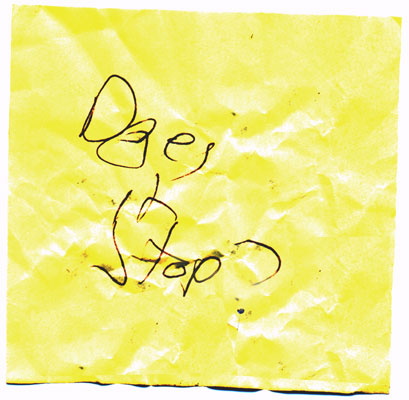
The other day, my husband found a cryptic message scrawled on a Post-it note by his computer: “Does it stop?”
He looked severe as he passed the note to me—so severe, I just had to laugh.
The content of the note was ominous. The form was ominous, too—the writing barely legible. Why, then, was I laughing?
Our son came rushing over to inspect the note. “That’s Mom’s handwriting.” I couldn’t argue with him. “But worse.”
Those two seemed so serious. Too serious. I tried to remember why I’d written, “Does it stop,” but nothing was coming to mind.
Two matching sets of brown eyes were fixed on me intently.
No pressure.
Does it stop? Does it stop?
Surely, I could not have been writing about multiple sclerosis. It’s been sixteen years since my diagnosis. C’mon, people. Give me some credit. I wouldn’t scribble an angst-ridden message about that.
Does it stop? I’d recently been on hold with the phone company. Had I written the note then?
Being on hold could feel interminable. But no. That wasn’t “it.” I didn’t write the Post-it while I was on hold.
Then, when?
What was, “it?”
It.
I quit laughing long enough to confess, “I don’t remember writing that.” Which merely served to ratchet up the tension. Apparently, I was not merely angst-ridden. I was amnesiac. And to top it off, I wasn’t even disturbed about being an angst-ridden amnesiac. There was the question of my laughter. Was my laughter not disturbing?
Sorry.
My son hypothesized, “Maybe you wrote it in your sleep.”
The note was indeed sloppy enough to have been sleep-written. But c’mon. I can—and do—write sloppily enough while fully conscious, as all who know me can attest.
I just didn’t buy the sleep hypothesis. But try as I might, I couldn’t disprove it. I could not recall the exact circumstances surrounding the Post-it note, which in my mind was an argument against its emotional significance. Surely, if I had crawled out of bed to scrawl a message from the depths of deep despair, wouldn’t seeing the note trigger some dark association? I was certain the Post-it had a trivial origin. Yet clearly, I was the only person in the room with that certainty.
For years, my husband has carried around this hip little black book—a Miquelrius—designated for jotting down his observations of my MS symptoms. I’ve never been tempted to peek inside. I find it all a bit… humiliating. When I’d first fantasized about becoming this man’s muse, I was thinking he might fill the pages of a very different little black book.
There is nothing remotely sexy about a long slow decline.
I could tell by the mood in the room that my husband was way past considering whether to include the Post-it note in his little black book. He was considering whether he should categorize the note as a symptom of depression, or as a symptom of cognitive loss. Both depression and cognitive loss crop up fairly often in the MS population.
I am no stranger to depression. Which is why I was pretty certain that, had I been struggling with depression, I would have been the very first to know.
Whereas, if I were struggling with cognitive loss—I would be the very last to know. Which made remembering the origin of the note all the more important. And all the more inaccessible.
The answer came to me a few hours later, while I was brushing my teeth. With my new electric toothbrush. The old electric toothbrush had made a buzzing sound every 30 seconds. It had put me in the habit of polishing every surface of each successive tooth, slowly and deliberately, so that each time the buzzer buzzed, I was exactly another quarter of the way through brushing. Four beeps equaled two minutes of another round of pristine dental hygiene. I would be just finishing the final wisdom tooth when the old electric toothbrush would emit a final, conclusive sounding buzz, and would turn off. The synchronicity had been very satisfying.
Over the years, however, brushing my teeth with the old electric toothbrush had become less than satisfying. The vibrations would cause the toothbrush head to shimmy up and off the communal toothbrush post. I quit using our old electric toothbrush months ago, preferring an old style manual toothbrush that didn’t suck up electricity or spit itself out. By the time my husband came around and bought us a new electric toothbrush set, I was thoroughly out of the habit of the two-minute brush.
Even so, I felt like the new electric toothbrush was working overtime. The new electric toothbrush beeped…and beeped…and beeped…and beeped, but I wasn’t in synch with it, like I’d been in synch with the old one. It seemed to me like this session was dragging on to be an awfully long two minutes. And then the answer to that nagging question finally came to me.
When I had written the Post-it note, I’d had a vibrating toothbrush in my mouth for what I could swear had been more than two minutes. The darn thing would just not shut off. I’d tried pressing the off button with my feeble finger. It only buzzed the louder. And vibrated more. So I’d sidled up to my strong-fingered husband as he tapped away on his computer. I couldn’t very well pull a vibrating toothbrush out of my mouth to ask him if this new fangled electric toothbrush was on a two-minute timer, like the last one. I reached for a pen. And a Post-it note.
And wrote…

author’s note: As it turns out, my husband had not posted the note in his little black book. He hadn’t been as concerned as I’d thought. When I went hunting for the visual aid, he recovered the crumpled Post-it from the trash.

← Back

Thank you for your response. ✨

Enter your email address to subscribe to this blog and receive notifications of new posts by email.

The Illumination

The Illumination
By Kevin Brockmeier

Every day, I am in pain. Every day, I read. Coincidence? Maybe not. I have multiple sclerosis to blame for my quotidian pain. But today I suffer from a form of pain that can’t be attributed to chronic illness, but rather, to chronic habit. I’ve got a crick in my neck. I blame the brilliant author Kevin Brockmeier. His novel, The Illumination, near immobilized me. It’s not the kind of book you walk away from (assuming you can walk.)
The premise of the novel is deceptively simple. One afternoon, there is a random change in the universe. Pain takes on a new property. Pain emits light.
To give an example: if I were a character in the world of The Illumination, there would be a white light emanating out the back of my neck, shimmering from the cervical through the thoracic regions of my spine. My tingly calves would glow with neurologic noise. It is entirely possible that my hair would be adorned with bright pinpricks, like the ones I see on MRIs of my lesion riddled brain. As my pain increases with the passing hours, so would the wattage. By nightfall, I’d be a beacon. It would be impossible to fall asleep or stay asleep beside me, as I am also an insomniac. No doubt I would be confined to a rocky outcrop on the coast of Maine, where I would be propped up facing the ocean. I would accept my fate as a living lighthouse, and wear a long white t-shirt dress with one thick red horizontal stripe.
Or maybe not. The actual characters in the Illumination are more interesting than that. They don’t come off as metaphors, but as ordinary people, doing the extraordinary job of expanding the narrative while simultaneously moving it closer to the goal. The personal, the religious, the literary, and the cosmic ramifications of The Illumination are explored from multiple points of view, all equally compelling. That’s quite a trick.
This playful narrative opens with a character that blames her pain on her ex-husband, in much the same way as I blame the crick in my neck on Kevin Brockmeier. It’s not Kevin Brockmeier’s fault that I got a crick in my neck trying to unwrap the many layers of meaning in his book, any more than it’s the ex-husband’s fault that his wife nipped off the tip of her thumb while trying to cut through a package he’d wrapped in “a thick layer of transparent tape, the kind fretted with hundreds of white threads, the latest in his long campaign of bring needless difficulty to her life.”
Brockmeier’s novel is fretted with perhaps hundreds of narrative threads, none of them needless, each a delight. I would love to dissect every chapter in this post; but I will leave the pleasure of discovery to you. It’s the first novel I’ve read that managed to coerce me into literally reading through another point of view. Get ready for the shock of recognition once you realize that this is not an ordinary novel, but an elaborate game. Move over, Nabokov.