“Lies are what the world lives on, and those who can face the challenge of the truth and build their lives to accord are finally not many, but the very few.” -Joseph Campbell
When I first went on daclizumab, I was euphoric. After going through six neurologists, and three MS medications, I finally found a brilliant neurologist who had uncovered an off-label medication that appeared to actually work.
My husband remained unmoved. He girded himself for every outcome, including the possibility that the medication would fail.
I shared his neutrality. At first. But then daclizumab surpassed my expectations. I had wanted nothing more than a medication that would prevent further exacerbations. What I got was a medication that did all that and more. Suddenly, I felt…able. I was able to hike and swim and lift weights. So I did. I pushed my suddenly able body to astonishing new limits. I rode the wave. I soared. My husband stood steadfast, like a beacon on the shore. He appreciated my toned body, but he didn’t expect it to last.
Indeed, it didn’t last.
No body lasts.
Love lasts.
Years passed. My physical capabilities became less and less astonishing. I had very much enjoyed becoming super-fit. As my physical parameters kept shrinking, I kept pushing back. It was with great reluctance that I finally learned to stop wanting more of my body than it can deliver.
This week, my hard-won acceptance was put to the test. I would have to also learn to stop wanting more of my medication than it can deliver.
The moment of truth arrived on Tuesday. I finally received the news my husband has been girding against ever since I started taking daclizumab, shortly after Tysabri was pulled from the market in ‘05. In all that time, my MRI’s have always come back with no further lesions. I’ve been lucky.
I’ve kept up on the preliminary results of the daclizumab trials, and while they are impressive, I couldn’t help but notice there hasn’t been a 100% cessation of disease activity across the board. Something had to give.
Now finally, something has.
My latest MRI came back with one enhanced lesion.
Just one little lesion, located in the so-called “silent area.” My local neurologist doesn’t think one lesion would be worth attacking with steroids. (And I must say, I’m relieved.)
The news of the MRI didn’t shock me. It was almost a comfort. I already knew I wasn’t well. It actually felt good to have some confirmation that there was a reason, even if that reason was inconveniently screaming from the “silent area.”
Daclizumab has worked wonders for me. But it is what is. It’s a medication—the best I’ve ever taken. It is not a miracle. It is not a cure.
Daclizumab is fallible. Just like me. That doesn’t mean it’s a failure.
I’m glad I haven’t been afraid to hope. Hope did me no harm, after all. Yes, I was once euphoric, but with good reason. I’d been given a reprieve. When the facts changed, I didn’t break. I changed along with them.
It’s been a good ride.
MS
Type A
Today a specialist asked me if I had a certain personality.
I may have responded with an arch look.
He rephrased the question. “How would you describe yourself? Your personality? ”
I knew where he was going with that line of questioning. He wanted me to confirm his at-a-glance hypothesis that I am a Type A personality. Apparently The Specialist subscribes to the popular theory that Type A personalities are more prone to autoimmune diseases like multiple sclerosis (MS.)
“Has anyone ever told you that you are a control freak?”
He has nothing to gain from this line of reasoning. Think about it. Of the two of us, who is more likely to have a Type A personality: the guy with the medical degree, or the gal with the MFA?
I countered, “I think that’s just blaming the victim.”
I don’t (necessarily) have a bad personality. I just have a bad disease.
The Specialist kept describing the Type A personality. “Do you set goals for yourself?”
“Sure I do. And maybe I’ll accomplish all of those goals in a day, and maybe I’ll only accomplish only one. Or none at all. My body has the final say.”
“So you’ve reached Acceptance.”
Acceptance. I didn’t know what The Specialist would think about that. Acceptance doesn’t carry much of a cachet among Type A personalities.
I ventured, “I don’t know if that’s good.”
Though of course, I do know that it’s good. In my case, Acceptance is reasonable. All my MRI’s in the past four years have come back showing no new lesions. It’s appropriate to reach Acceptance when you’re on a drug that actually works.
The Specialist was happy to hear about the efficacy of the drug, even though he couldn’t find “daclizumab” or “DAC HYP” on his portable information device. (I probably spelled it all wrong.) He seemed more frustrated that he couldn’t shoehorn my personality into his Type A hypothesis. He kept trying. He listed high achievers who had autoimmune diseases. Montel Williams’ MS. Michael J. Fox’s Parkinsons.
I could think of one other thing these guys had in common, besides autoimmune diseases. “These guys are both celebrities. You kind of have to be a high achiever to become a celebrity.”
Whereas, you absolutely don’t have to be a high achiever to become a patient with MS. It’s just not that simple. I know plenty of high achievers. And most of them are not celebrities. Most of them don’t have an autoimmune disease, either. Nor do they deserve one.
I don’t deserve one, either.
“Do you think you used to have a Type A personality, back before your diagnosis?”
Back before my diagnosis, I’d majored in philosophy. What kind of Type A personality would be stupid enough to major in a thing like that?
The kind of Type A personality who thought English majors weren’t thinking hard enough.
Fine.
Have it your way, Specialist.
He proposed, “Some people think meditation could be helpful for people with multiple sclerosis.”
So now he’s “some people.”
“Meditation could be helpful for anyone.”
Touché.
I’m not making a very good case for my being a Type other than A.
The Specialist is an Ear, Nose, Throat guy.
He finally got around to asking me to stick out my tongue.
“You know, thousands of years of Chinese medicine has taught them to diagnose an entire person with one glimpse of the tongue.”
Diagnose?
Or simplify?
I had my tongue sticking out, so I couldn’t reply. And anyway, I didn’t think of a good comeback until after I left the examining room. Here it is: “For hundreds of years, Gypsies have said they can see a person’s fate with one glimpse of the palm.” You don’t see me rushing out to consult any gypsy. I consulted my half-Chinese husband instead. My half-Chinese husband said my sharp tongue was one of the first qualities he loved about me.
So maybe there is a perk to being Type A, after all.
The Specialist had said, “Things happen for a reason.”
I agree with half of that statement. Things happen. But If you’re going to look for a reason, don’t stick your tongue out at a Chinese guy, and thrust your palm onto a gypsy’s lap. That’s just silly. None of us are so special we should waste our breath whining, “why me?”
I may have a strong personality, but I don’t think it’s so strong it could cause a disease.
While I was waiting for The Specialist, I was reading Population 485, a delightful book by a Michael Perry, a volunteer fireman. He writes, “We are creatures of myth, hungry for metaphor and allegory, but most of all, hungry for sense.”
Sometimes our hunger for sense has us gobbling up nonsense.
Perry writes, “Surely, we tell ourselves, we can’t die just because we hit a patch of pebbles on a curve.”
But as Perry clearly illustrates, we can and we do.
We identify with our problems, with our illness, with our fate, instead of detaching, and researching cause and effect.
I think I’ve figured out why I contracted MS. It had nothing to do with my personality, and everything to do with my intestinal parasites.
Surprised? So was I.
It’s a wild, random world. (Is this the observation of a Type A control freak?)
Namaste.


Does it stop?
The other day, my husband found a cryptic message scrawled on a Post-it note by his computer: “Does it stop?”
He looked severe as he passed the note to me—so severe, I just had to laugh.
The content of the note was ominous. The form was ominous, too—the writing barely legible. Why, then, was I laughing?
Our son came rushing over to inspect the note. “That’s Mom’s handwriting.” I couldn’t argue with him. “But worse.”
Those two seemed so serious. Too serious. I tried to remember why I’d written, “Does it stop,” but nothing was coming to mind.
Two matching sets of brown eyes were fixed on me intently.
No pressure.
Does it stop? Does it stop?
Surely, I could not have been writing about multiple sclerosis. It’s been sixteen years since my diagnosis. C’mon, people. Give me some credit. I wouldn’t scribble an angst-ridden message about that.
Does it stop? I’d recently been on hold with the phone company. Had I written the note then?
Being on hold could feel interminable. But no. That wasn’t “it.” I didn’t write the Post-it while I was on hold.
Then, when?
What was, “it?”
It.
I quit laughing long enough to confess, “I don’t remember writing that.” Which merely served to ratchet up the tension. Apparently, I was not merely angst-ridden. I was amnesiac. And to top it off, I wasn’t even disturbed about being an angst-ridden amnesiac. There was the question of my laughter. Was my laughter not disturbing?
Sorry.
My son hypothesized, “Maybe you wrote it in your sleep.”
The note was indeed sloppy enough to have been sleep-written. But c’mon. I can—and do—write sloppily enough while fully conscious, as all who know me can attest.
I just didn’t buy the sleep hypothesis. But try as I might, I couldn’t disprove it. I could not recall the exact circumstances surrounding the Post-it note, which in my mind was an argument against its emotional significance. Surely, if I had crawled out of bed to scrawl a message from the depths of deep despair, wouldn’t seeing the note trigger some dark association? I was certain the Post-it had a trivial origin. Yet clearly, I was the only person in the room with that certainty.
For years, my husband has carried around this hip little black book—a Miquelrius—designated for jotting down his observations of my MS symptoms. I’ve never been tempted to peek inside. I find it all a bit… humiliating. When I’d first fantasized about becoming this man’s muse, I was thinking he might fill the pages of a very different little black book.
There is nothing remotely sexy about a long slow decline.
I could tell by the mood in the room that my husband was way past considering whether to include the Post-it note in his little black book. He was considering whether he should categorize the note as a symptom of depression, or as a symptom of cognitive loss. Both depression and cognitive loss crop up fairly often in the MS population.
I am no stranger to depression. Which is why I was pretty certain that, had I been struggling with depression, I would have been the very first to know.
Whereas, if I were struggling with cognitive loss—I would be the very last to know. Which made remembering the origin of the note all the more important. And all the more inaccessible.
The answer came to me a few hours later, while I was brushing my teeth. With my new electric toothbrush. The old electric toothbrush had made a buzzing sound every 30 seconds. It had put me in the habit of polishing every surface of each successive tooth, slowly and deliberately, so that each time the buzzer buzzed, I was exactly another quarter of the way through brushing. Four beeps equaled two minutes of another round of pristine dental hygiene. I would be just finishing the final wisdom tooth when the old electric toothbrush would emit a final, conclusive sounding buzz, and would turn off. The synchronicity had been very satisfying.
Over the years, however, brushing my teeth with the old electric toothbrush had become less than satisfying. The vibrations would cause the toothbrush head to shimmy up and off the communal toothbrush post. I quit using our old electric toothbrush months ago, preferring an old style manual toothbrush that didn’t suck up electricity or spit itself out. By the time my husband came around and bought us a new electric toothbrush set, I was thoroughly out of the habit of the two-minute brush.
Even so, I felt like the new electric toothbrush was working overtime. The new electric toothbrush beeped…and beeped…and beeped…and beeped, but I wasn’t in synch with it, like I’d been in synch with the old one. It seemed to me like this session was dragging on to be an awfully long two minutes. And then the answer to that nagging question finally came to me.
When I had written the Post-it note, I’d had a vibrating toothbrush in my mouth for what I could swear had been more than two minutes. The darn thing would just not shut off. I’d tried pressing the off button with my feeble finger. It only buzzed the louder. And vibrated more. So I’d sidled up to my strong-fingered husband as he tapped away on his computer. I couldn’t very well pull a vibrating toothbrush out of my mouth to ask him if this new fangled electric toothbrush was on a two-minute timer, like the last one. I reached for a pen. And a Post-it note.
And wrote…
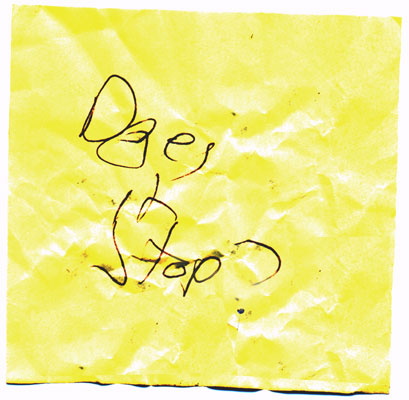
author’s note: As it turns out, my husband had not posted the note in his little black book. He hadn’t been as concerned as I’d thought. When I went hunting for the visual aid, he recovered the crumpled Post-it from the trash.
Conjoined Twin
The cover girls on this morning’s New York Times Magazine are cute young twins…conjoined at the head.
My son, an only child, could not imagine himself in such a conundrum. Since I have two sisters, it was easier for him to imagine such a thing happening to me.
“You probably wouldn’t like it if you were conjoined with one of my aunties.”
I immediately imagined an even worse scenario.
“Image how she would feel being stuck conjoined to me! She’d want to go out…and I wouldn’t be able to walk fast enough. She’d be dragging me along! And then I’d stop walking altogether. And she’d be stuck! She’d hate it!”
And then it hit me; I can imagine this hypothetical situation so well because that’s exactly the situation that I’m in. My MS is like a pesky conjoined twin with a will of her own.
Take this morning, for example. I wanted to pull weeds. But I had to drag along my pesky twin, MS. Let’s pretend MS is short for Mary Sue.
It’s a beautiful, clear day. Blue sky, fluffy white clouds. 80 degrees. Finally, no rain. Finally, a chance to pull those 16” weeds!
Mary Sue whines about the heat. I’ve gathered only a handful of weeds, but we go back inside. I pour us some ice water. A compromise. We go back out again. Gosh, it’s beautiful day.
Mary Sue starts whining again. Now she’s making our legs all tingly and heavy.
I ignore her, and pull. Satisfied to be finally getting something done.
The little girl across the street shouts, “Hello!”
“Hello!” I call. I smile and wave. I can’t see the little girl.
Mary Sue has gotten us dizzy.
I drink more ice water. Mary Sue complains that we are going to faint. She complains about our legs getting heavy.
Our legs have indeed gotten heavy. (Thanks to Mary Sue.) I drag our legs all the way down to the compost bin in the back of the yard, and dump what weeds I’ve managed to uproot.
I turn for home. Mary Sue is dragging our feet all the way to the front door, and her precious air-conditioning.
We’re inside. She’s won. I plop down, exhausted from our struggle, and read a book.
Mary Sue is outraged. I’m ignoring her. She finds a new way to make trouble.
Outside, she was too hot. Inside, she’s decides she’s too cold. She starts jerking our legs around in painful spasms. I stretch. She whines. I pull on long pants. She quiets down.
I dream of separation.
I long for a cure.
Love and Death on Cape Cod
I’ve spent all but one day this week imprisoned in fatigue, but on that day I got to walk my dog, catch up on laundry, and begin an essay for your entertainment. The essay isn’t done yet. I’ll throw you a scrap from another piece of unfinished writing, the opening to my novel-in-progress, Love and Death on Cape Cod. If it leaves you wanting more, welcome to my world.
Love and Death on Cape Cod
in Memory of Esme
Chapter 1. This Is Not My Beautiful House. This Is Not My Beautiful Wife.
It was the oil hemorrhaging into the Gulf of Mexico; it was in the traffic clotting eastbound 95; it was the ever-expanding estimates on NPR; 1,000 gallons a day; 6,000; 25,000.
It was his complicit commute.
It was the dispersant; the unknown quantities of unknown compounds with unknown effects. It was the nation-wide malaise. It was the end of Yes We Can. It was mass extinction. It was global warming. It was mountain top removal. It was plastic. It was that vast continent of plastic, silent as a tumor, floating somewhere in the Pacific, unnamed. It was overfishing. It was overpopulation. It all came down to overpopulation. It was hormones in the water supply.
It was Laurel Hansen’s raging hormones.
It was 3 am on Saturday, June 5, 2010— Day 44 of the BP catastrophe.
Jay Carr lay sleepless in his beachside cottage in Madison, Connecticut. Laurel lay beside him, her breathing as steady and rhythmic as the Long Island Sound lapping against the sand. Jay suspected Laurel was dreaming—literally dreaming—of mothering his child. Over six billion people on the planet already, and somehow Laurel found her world incomplete without the promise of one person more. Laurel was thirty-eight, on the verge of thirty nine, on the verge of too late. Jay was familiar with the feeling of a world, incomplete. There had been only one person who had managed, however briefly, to make his world complete.
Only one.
Ms. Lab Rat in trueFoolishness
I have been aided in the transition from writing to live storytelling by true professionals. I am thankful to Jeff Groh and Dave Levy for pushing me to succeed, and to my fellow performers, for demonstrating how to rock the house. We laughed, we cried, we clapped, we SANG.
There was an accordionist! A jug band! Yep. Good times.
Don’t take my word for it. Read this review! https://www.facebook.com/notes/rick-penders-theater-stages-scenes/true-theatre-truly-surprising/197718950266519
You won’t want to miss the next show, themed trueIndepence:
http://www.cinstages.com/Onstage/proddetail.asp?ProdID=130315.


trueFoolishness: The Handicapped Decal
April 11, 2011, Know Theatre:
Somebody stole my handipcapped parking decal this weekend.
This is what I’m hoping. I’m hoping you’re a little confused. I’m hoping, as you look at me, you’re thinking, why would she need a handicapped parking decal? She doesn’t look handicapped.
‘Cause that’s what I thought, too.
I was diagnosed with Multiple Sclerosis in 1994. It would take me over eight years of hemming and hawing and handwringing to finally get around to applying for a handicapped parking decal.
Me? Handicapped?
I wasn’t handicapped.
Yeah, I had MS. But I didn’t think that meant I was handicapped. The figure in handicapped icon is in a wheelchair. I wasn’t in a wheelchair. Not most of the time.
I have the Relapsing/Remitting form of MS. The most moderate form of multiple sclerosis there is. MS for wimps. In the early weeks, I attempted to educate myself about the disease by meeting other people with MS. Bad idea. Most of them had Primary Progressive Multiple Sclerosis, a way harsher form of the same disease. If Relapsing/Remitting MS is like MS for wimps, Primary/Progressive MS is MS for heroes. I wasn’ t a hero. And I was in no hurry to become one.
I’ve gotta admit, I was put off by the wheelchairs. And the walkers…and the speech impediments. I was downright terrified by the cognitive losses. The loss…for…words.
The Primary Progressives, they tried their best to inspire me.
Instead, they scared the shit out of me. Let me make one thing perfectly clear. When I say the Primary Progressives scared the shit out of me, I am not speaking literally. An important distinction between me, and some brave souls with Primary Progressive MS.
Primary Progressives, they could keep their heroic positive outlook. They could keep their handicapped parking spots. I didn’t want to go there.
But there was always the likelihood that I would end up there eventually.
Multiple Sclerosis is an insidious disease. It turns the T-cells of your own immune system against you. T-cells are designed to attack outside invaders. But once MS gets hold of them, they turn into zombies, and they mindlessly march forward and attack your own Central Nervous System instead.
What happens when your zombie T-cells rip open the myelin sheath protecting your nerve cells? That all depends on three important factors: location, location, location.
No two people with MS have the same symptoms, because no two people are struck with attacks in exactly the same locations. Over the years, I’ve taken a lot of comfort in that. But let’s face it, there is no good place in your Central Nervous System to suffer an attack. Let’s think about the role of the Central Nervous System— the brain and the spinal cord. Together, they coordinate just about every aspect of yourself, functions you think you control, like your speech, your range of motion, your ability to swallow, oh yeah, and your ability to void your bladder…your bowels. They also control all those functions you take for granted that go on without your conscious direction, functions like your heartbeat.
Scary, huh?
Many of my earliest MS attacks happened to have taken place on my spinal cord, and those attacks caused sensory symptoms; numbness and tingling in my legs; damage no one else could see.
Once, the tingling went all the way up my bra line. Only once. After a few hours, it went back down again. That’s classic example of RRMS. The beauty of it is, some symptoms show up, and then they disappear for good.
Consequently, I never do get too attached to my MS symptoms. I expect them to leave me. Some symptoms, the oldest ones, seem to have more trouble letting go than others. Some keep coming back for more.
One symptom in particular just kept coming back. There were moments when my legs would dissolve from beneath me. Those moments would come with no notice while my husband and I would be out on the town. Maybe I’d be just fine walking to the car, but then I wouldn’t be able to walk back out. My husband would have to take on the dual role of valet-parking-attendant/living-human-crutch, and would be forced to juggle parking the wife with parking the car. A handicapped-parking permit would have made those moments a lot easier. For my husband.
But me?
I regarded those moments as flukes. Was there some sort of Momentarily Handicapped Decal? A Relapsing/Remitting Decal? A handicapped icon without a wheelchair? I’d take one of those.
But they don’t make ‘em.
Over the years, those flukes piled up. Too many flukes, and you’ve got yourself a trend.
Most memorably, there was the Wisdom Tooth Fluke. We had planned for my husband to get IV valium that morning. We hadn’t planned for the ice storm. We hadn’t planned for my legs to give out the moment my husband draped his arm around me. The dentist had to request two wheelchairs, and two orderlies, to escort us both out. We were wheeled as far as the exit, where we sat side-by-side in our matching wheelchairs and stared across a glassy parking lot of solid ice. Our little green Ford Escort was parked somewhere out in the back. Yep.
The dentist had been generous with his valium. My husband was generous with his praise of the orderlies, even as they informed us we had reached the end of the line. “Thanks for the ride, guys, you’re the best. Fun!”
This, after they told us they weren’t authorized to take us any further.
So after the wisdom tooth fluke, you would think I would apply for a handicapped parking decal. No way. My husband couldn’t lose all his wisdom teeth twice, right?
Years went by. We moved to Connecticut, to be closer to my parents, to have more people to lean on during those little flukes. I ignored all the tactful suggestions that our life could be easier with a handicapped decal. I wasn’t focused on being handicapped. I was focused on having a baby, while I was still up and about. And then I was focused on raising our son.
But MS isn’t like a plant that dies if you ignore it. The MS was thriving, with or without my attention.
Remember those tingly sensations I was telling you about? That sensations only got worse when I tapped the gas and the brake.
I had a job teaching fiction writing workshops. I had to drive to get there, right? If there’s anything MS has taught me, it’s to be resourceful. I would count on using cruise control on the highways, instead of the gas and the brake. The only problem was the traffic jams.
After twenty minutes of so of a traffic jam, the tingling sensation would build to something excruciating. It was more than a little distracting. I was a mother now. I couldn’t die on the highway. My little guy couldn’t die on the highway. Cruise control wasn’t adequate. I had to resort to a new Plan B. I graduated from cruise control to hand controls.
And that’s how I met Luigi, the man who would finally convince me to apply for a handicapped decal. Luigi was a professional. He was sent by the State of CT to train me how to use hand controls. I picked it up right away, faster, he said, than his usual MS clients. Luigi was obligated by the State of CT to stick around and watch me drive for three entire days. Near the end of our sessions, he asked why I didn’t have a handicapped decal. All his other drivers with MS had decals. Why didn’t I?
I was hurt. Didn’t he get it? Hadn’t he said I was different than his other MS clients?
I asked, in all seriousness, “You think the State would give me one?”
Luigi looked at me funny for a moment. I couldn’t figure out what his expression meant. I decided not to read anything into it. But something was up.
After a long pause, Luigi finally spoke. “You say you’re a writer. A fiction writer. Just write up a good case to your neurologist. If you make convincing, he’ll set you up with a handicapped parking decal.”
Well, since he put it that way, I could see the logic. Applying for the decal would be like applying for the hand controls. I approached the task as a way to milk another perk from the leaky system, to obtain another little trophy, like that nifty new turning knob on my steering wheel.
I wanted to write that letter as a fiction writer, but the truth kept getting in the way. The thing turned into a long, tortured, multiparagraph treatise on how I would only use the decal for good, never for evil, how I would never park in a handicapped spot on my good days, just because the spot was there and I was already late for the movie and there were all those other handicapped spots open if any more-deserving handicapped-er driver happened to need one. Or something to that effect.
I posted the letter like I post submissions to the New Yorker. I had very little hope my neurologist would buy my story, and even less hope that the State of CT would ever be conned into sending a real honest to God handicapped parking permit to a healthy person like me.
Once I sent the letter, I forget all about it. One day insultingly soon thereafter, I got a package in the mail from the State of CT.
My six-year-old son watched me pull the handicapped decal out of the envelope. There it was, the icon in the wheelchair. I very much aware I was being watched.
“Good news!” I cried. “I got a handicapped parking decal.”
My eyes went to the expiration date.
LIFETIME
That meant I would never have to apply for another handicapped decal.
LIFETIME
That meant I was officially handicapped for life.
My son’s eyes had gone wide. He stood transfixed on the staircase, studying me. “Are you sure that’s good news, Mommy?”
“Of course it’s good news.”
Already, I was thinking that LIFETIME bit would some day seem ironic. No way would I would I be handicapped for life. There would be something, some medication that would stop the T-cells from turning into zombies. Some medication to fix all the damage in my brain. I would take it, me and all the other brain damaged people, and everyone else would be jealous of us. We would turn into some superior race.
That very afternoon, I drove my son to his favorite place in the whole world, The Peabody Museum. We got to park directly in front, instead of having to park in the lot two city blocks behind the entrance. Which meant Mommy got to stand by his side a whole ten minutes longer in the Great Hall of Dinosaurs. It didn’t take me too long to figure out that we’d missed out on many many ten minute increments of our precious time together in all the years I’d been too proud, or worse, too vain, to apply for a handicapped permit.
It took me until tonight to figure out the real villain in the story of the wisdom tooth fluke. It wasn’t the orderlies who wanted to leave us in our wheelchairs at the edge of the icy parking lot—and by the way, I did not let them get away with that. No. I was angry at them, really angry, but maybe because, deep in my heart, I already knew the real villian in the Wisdom Tooth story was me. I’d been one to park the car at the back of the freaking icy lot. All because I’d been too proud…or worse, too vain, to break down and admit I was a handicapped person, who needed a handicapped parking space.
But I’m not going to get too harsh on myself.
The objective truth of the matter is, nobody wants a handicapped parking space.
Since our family moved to Cincinnati, our car has been broken into four times. The first three times, the thieves took the GPS, and left the handicapped-parking permit untouched. It was almost insulting. I’ve gone through hell with Multiple Sclerosis, and all I’ve got to show for it is a lousy Handicapped Parking Permit.
It has to be worth something, right?
This weekend, a thief finally agreed with me. Whoever nabbed the thing validated my observation that a handicapped parking permit is actually worth quite a lot. This time around, I won’t be wasting eight years hemming and hawing and handwringing before I get around to applying for another handicapped parking decal. I’ve already downloaded, printed, and filled out the form.
As for a letter to my neurologist? I think this one will do.
author’s note: I tried to get away with using an earlier version of this story based on my blog post, “Expiration Date.” That version only runs about three minutes. The producers, Dave Levy and Jeff Groh, wanted something that ran at least ten. They very patiently endured my objections, as a writer, that I could tell only the essentials of my story, that an extra seven minutes would be just fluff. And then they helped me dig deeper, and mine the many comic possibilites I’d been too blind to see.
Jeff and Dave, this one’s for you.
How to Take a Fall
When I was a child, my parents would take us girls hiking in Sleeping Giant Mountain with the regularity of the devout. Weekend after weekend, without fail, we’d hike the same old wooded trails.
One afternoon, when I was maybe nine or ten, I scrambled off the trail and up a ruddy rock face. I craved a change of perspective. Why not go vertical? I liked the challenge of having to figure out where to place each hand and foot.
Did my mother call after me?
I’m certain she did.
I am just as certain I pretended I was too high up to hear her. I was higher than my Dad, and he was six foot four. That would put me pretty much on top of the world.
In my family, there was nothing more gratifying than eliciting my mother’s panicked call. The terror in her voice was always music to our ears. Typically the surest way to achieve this lofty goal was to scramble up all four levels of the “castle,” the stone tower at the summit of Sleeping Giant, and hang off the overlook as far as you dare, pretending to take in the view of far-off New Haven and maybe the distant sparkle of the Long Island Sound.
This particular rock face was at the base of the mountain, yet already I’d managed to stoke my mother’s fear of heights. Most excellent. I’d beaten my sisters to it. I half expected they’d be scrambling up after me, ostensibly to set things right.
Let them try.
It wasn’t all that easy, scaling a rock face. One false move, one careless grasp on a loose rock, and my little sibs would go tumbling down. Only I had the courage, only I had the brain power, only I had the grip…
Only…
I slipped.
Time slowed down for this humbling event, just as obstinately as Time speeds up for ice cream cones. Once I lost my grip, I didn’t bother to grab for an anchor to break my fall. I tucked in my chin, and curled up in a ball.
My highest priority was to protect my eyeglasses. By the tender age of nine or ten, my unassisted eyesight was already vague and amorphous, kind of Van Gogh Starry Nightish, but without all the detail. My eyeglasses meant everything to me. They were the essential component for both my physical survival and my complete social annihilation. This was the 1970’s. The fashion—I am using this term loosely—of the day embraced the notion of ‘bigger is better’ for eyeglass frames. This notion was wrong. Flat out wrong. But no matter how patiently the ophthalmologist explained that choosing bigger frames would result in thicker lenses, I adhered to this misguided trend. As a result, the lenses of my eyeglasses were easily half an inch thick along the edges, which meant my peripheral vision was absurdly distorted. Even with the distortion, seeing through glasses as better than seeing hardly anything at all. So no, I wasn’t about to lose those odious looking glasses. Not in this fall.
Down I tumbled, curled up tight, and tucked myself in with all of my might. I rolled over rocks, roots and mosses alike. What was a little bump…or a big bump…a little scrape…or a tear…just so long as my glasses were spared?
I was not the type of child to tumble down a rockface and let a pebble go unnoted. I must have registered every indignity allotted to me on my journey down. Imagine my surprise, then, when I finally found my feet after my fall…and discovered I had somehow lost my glasses in the process.
Now that made me sore.
My father was crowing, “Congratulations! That was perfect! You really know how to take a fall!”
My mother was cooing and pulling the leaves from my hair. I wasn’t looking for praise, or even consolation. I was looking for my glasses.
“Where are my glasses? Has anyone seen my glasses?”
My sisters sprang into action, vying for the chance to save the day. My mother plucked my glasses off a sprig of mountain laurel. I snatched them out of her hand, and immediately tried them on. There was a scratch on the right lens.
“There’s a scratch!” The lens would have to be replaced. I had failed.
My father said, “One lousy scratch. And only on your glasses.” I didn’t understand. Shouldn’t he be upset? He’d have to pay the optician. “You’re gonna do well, kid. You’ve got what it takes. The trick to getting through life is knowing how to take a fall.”
In the sixteen years since I was diagnosed with multiple sclerosis, my parents have since seen me face many a fall.
Scaring Mom just isn’t fun anymore.
I can offer my parents one consolation. They can think back to that afternoon on Sleeping Giant. Their oldest daughter knows the trick to getting through life. They can be certain I know how to take a fall.
Visualization 3.0
My third draft of the Visualization essay, with thanks to Jeff Groh for coaxing out another thread:
For all my adult life, I’ve done my best not to be defined by multiple sclerosis (MS). It’s easiest to escape other people’s pity, and other people’s judgments, if they don’t know I’m disabled in the first place. Because I have relapsing/remitting MS, most of the time I can still get away with passing for a Normal. But only to the untrained eye.
No matter how gracefully I walk into a neurologist’s office for my annual evaluation, the dreaded heel-to-toe test invariably punctures my façade.
As soon as I place one heel directly in front of the other foot, I start to sway. My arms float up, like a gymnast…a gymnast on the Titanic. I tilt toward the left. I regain my balance…for one brief hopeful moment. I tilt toward the right. My legs start to buckle. Then twist.
It’s all very suspenseful.
Inside my atrophied little brain, I’m reminding myself of all these tricks I’ve been taught at yoga. I press into all four corners of my front foot. I root down into my tail-bone. I lengthen my spine. Oh yes. I breathe.
I lift my back foot. Gently swing it around my front foot. Start to set it down…
Oops.
Not again.
I tilt toward the right. A little too far. I break my fall…by breaking out of heel-to-toe.
Inside my atrophied little brain, I’m thinking that losing my balance is all my fault. I wasn’t…yogic enough. I didn’t make the right mind-body connection. Of course! Mind-body connection! Why didn’t I think of it sooner? What I should have done was visualize myself walking down the hallway.
Visualization. That’s the ticket.
I request another try.
This request typically inspires a panic.
“Oh, no, no, no. That’s fine. You don’t have to do that one over. I’ve seen enough.” And I wind up feeling like an out-of-work actor who has just asked for a re-try on a crappy audition.
The first time I took the heel-to-toe test, I made a lame joke. “I guess my tightrope walking days are done.” The joke fell flat. My stand-up comedian days were dead-on-arrival. Fine. I don’t want to play the role of the wisecracking patient with multiple sclerosis. I don’t want to be in that sitcom. Or even on that channel. I’d rather be on the yoga channel, floating two feet above the gleaming wooden floor without even noticing, a tiny, enigmatic smile on my placid face.
Yeah, right.
As soon as I got diagnosed with multiple sclerosis, I got it into my head that I could fight off the disease by learning yoga. My first yoga instructor told me I was being unrealistic. That was sixteen years ago. A lot of people with MS don’t last this long without ending up in the wheelchair. Maybe I’m still walking because I have a more mild form of the disease. Or maybe I’m still walking because of yoga.
I wish I knew. I just can’t say. I don’t have a control group; a clone or a twin sister with multiple sclerosis who thinks yoga is a complete waste of time.
What I can say is that my expectations for my balance are consistently higher than my performance in the heel-to-toe test.
My performance in my normal daily routine can be fairly convincing. I pass for a relatively fit healthy woman at least 90% of the time. In public. Before 8 pm. But still. I’ve got a good façade going. I’m fond of it. I don’t want that façade punctured. Which is why I don’t like the heel-to-toe test. Not one bit.
I never thought I could ever meet a person who could make my objections to the dreaded heel-to-toe test seem petty. That was before I met Dr. X.
I wasn’t supposed to be meeting Dr. X in the first place. My appointment was with Dr. Y. It so happened that Dr. Y was running behind, so she sent in a resident. Into the examination room wheeled…a black man…in a wheelchair. To see me: a white woman who felt irked every time she was asked to take the dreaded…never mind.
The instant I saw him, I realized I was operating on a cruel assumption…the assumption that losing my balance was a failure of my willpower, rather than just a manifestation of a cruel disease. I would never assume that this neurologist was a failure for being in a wheelchair. Why then, did I consider myself a failure for flunking heel-to-toe?
When Dr. X had me take the heel-to-toe test, I failed it, as usual.
But this time, failing the heel-to-toe test felt fairly privileged. At least I wasn’t stuck in a wheelchair. Dr. X would trade places with me in a flash.
Or would he?
Was Dr. X’s life really all that bad? Is mobility, or lack thereof, the decisive factor in anyone’s quality of life?
As we chatted afterward, I came to see that Dr. X’s life was actually pretty good. He was nearly done with medical school. He was on the verge of a lucrative career. He had a job lined up for him in his home state, where he could live near his beloved family of origin. His upcoming move wasn’t all he was looking forward to; he was getting married in a few weeks. His honeymoon plans included snorkeling in the Caribbean.
My atrophied little brain thought it appropriate to mention a book I’d just read, The Body Has a Mind of Its Own. I enthused about the data showing that visualization could improve sports performance, and shared my plans to visualize walking down my staircase without using the banister.
Dr. X’s response? “Use the banister.”
I take it Dr. X doesn’t visualize leaping out of his wheelchair. Or passing heel-to-toe tests. Dr. X is more focused on what his brain and his body can actually do. I’ll be the first to concede, his brain and his body can do quite a lot. So much for visualization. Maybe there’s something to be said for looking around, and seeing the world clearly. The world is a beautiful place, from any perspective. I bet the world looks spectacularly beautiful while snorkeling in the Caribbean.
Altogether, I left my examination with Dr. X a little less fearful, and a lot less judgmental, about the likelihood of my ending up in a wheelchair. I figured I was done freaking out about flunking heel-to-toe.
The funny thing is, the next time I took the heel-to-toe test, I did pretty well. When it was time to begin, I looked down the hallway, and thought, screw visualization. But some habits die hard.
I automatically deployed those tricks I’ve learned at yoga. I rooted down into my tailbone. I lengthened my spine. I breathed.
I pressed into all four corners of my front foot. I lifted my back foot. Gently swung it around my front foot. Set it down…
I didn’t tip.
I just kept on going.
One step. Two steps. Three. Four.
One foot in front of the other. Like any Normal would do it. Five steps. Six. Like any Normal moron. Seven.
My legs buckled. I swayed.
Eight.
I had to break out of it, or fall.
Old habits die hard. I called to my neurologist, “Sorry!”
And felt instant self-loathing.
My neurologist tilted her head. She looked puzzled. “What do you have to apologize for?”
Exactly.
Would Dr. X apologize?
I don’t think so.
“You’re right.” I agreed. “I have nothing to apologize for. So I flunked the heel-to-toe test. I have MS.”
She was still looking at me funny. “Actually, you didn’t flunk it this time. Your score was perfectly normal.”
Normal! Precious Normal!
That was just what I wanted, right?
Instead of feeling satisfied, I felt chagrined. I will only truly pass the heel-to-toe test when I don’t define myself by the results.
My Gut Feeling About MS

Security is mostly a superstition. It does not exist in nature,
nor do the children of men
as a whole experience it.
Avoiding danger is no safer
in the long run than outright exposure.
Life is either a daring adventure, or nothing.
–Helen Keller
Once upon a time, I was a wholesome, healthy, teenage girl. There was nothing I would rather do than backpack with my family in the forest, and nothing I would rather drink than pure, rushing river water.
Little did I know that nothing in nature is pure.
I discovered early on in our family’s backpacking adventures that the appearance of water is deceptive. I had only to fill my canteen to learn that water, while as clear as air, is nowhere near as light as air.
I should have figured right then that there is more to water than meets the eye. But I didn’t. I didn’t understand that water, essential water, delicious water, could kill me. The water from the streams tasted so much better than the water from the tap. How could it not be better? Purer? Safer?
Instead of following that old backpacking mantra, Take nothing but photographs, leave nothing but footprints, I took home a bellyful of worms I’d sucked down with that pure, rushing river water I’d found so delicious. Once those worms found their way into my digestive track, they began to wreck havoc.
Those little squatters would devour over three month’s worth of progressively blander breakfasts, lunches and dinners. Every one of “my” meals would be followed by violent, punishing diarrhea.
Life with these new parasites was ugly. Really ugly. In the course of three months, I was reduced to a (barely) living skeleton. I had to drop out of school, and rely on visiting tutors. As I became progressively weaker, I would have to send my tutors home early; sitting up for more than fifteen minutes at a time became too strenuous a challenge.
At one point during the parasitic occupation, I had a nasty reaction to an antibiotic. My esophagus contracted. I did not like that sensation. I thought I was having a heart attack. I remember my dad driving me to the hospital, reaching 50 miles an hour in a 35 mph zone. I was touched by his efforts, but I found them unnecessary. I’d had a nice life, if a short one; a loving family, gorgeous scenery, delicious water. I was ready to die.
In a less developed part of the world, I probably would have died, if not that day, then soon after. I certainly would not have reached adulthood. But as it happened, my dad was speeding me toward the teaching hospital at Yale University. The hospital would eventually connect me to an IV to boost my nutrition. They would treat me with an all-purpose parasite-killer. I would survive. The worms would die.
It was a real Ivy-league outcome. A victory.
The odd thing was, even after the parasites were killed, I never felt fully recovered.
I would live to adulthood, but it would be an adulthood with multiple sclerosis, a degenerative, debilitating autoimmune disease. Was that better than the alternative?
You bet.
Back when I was ready to die, I’d had no idea of all I would have missed. Instead of feeling serene, I would have felt really sorry for myself. Life is good. Even life with MS.
If you’ve been paying attention, by now you’ve probably reached the following conclusion: worms are bad. That was my assumption, too.
Imagine my surprise, then, when my friend Martin, a neuroscientist, sent me an article from The Annuals of Neurology, Association Between Parasite Infection and Immune Responses in Multiple Sclerosis (1), which observes that in the battle against multiple sclerosis, worms are…good.
The study compared multiple sclerosis patients who had naturally occurring parasitic infections to multiple sclerosis patients without parasites. The patients with parasites showed significantly less neurological damage over the course of four and a half years than the patients without parasites. Apparently worms are good for something. They keep autoimmune malfunctions in check.
At first, I resisted this data. I’d hosted more than my fair share of parasites. Those nasty little worms hadn’t kept me from contracting multiple sclerosis. But on second thought, I realized I hadn’t been a very nice hostess; I’d served up some heavy-duty all-purpose parasite killer. All the creatures living in my gut, good worms or bad worms, had been effectively wiped out.
Until I read the article, I never thought that was a problem. But now I do. This is why. Human beings have been co-evolving with parasites for millennia. It’s only recently that we’ve acquired the ability to produce heavy-duty all-purpose parasite killers like the one that saved my life. And it’s only very recently that we are beginning to realize there could be a trade-off. Tiny studies of disparate autoimmune diseases are all reaching the same conclusion; the immune system is regulated by the worms in our gut. (2)
Epidemiological data supports these findings. There is almost no incidence of autoimmune diseases like multiple sclerosis in the developing world, where modern standards of hygiene have not yet impeded on the dark, fragile ecosystem we prefer not to discuss in polite company. (3)
Biodiversity may be endangered in an ecosystem we rarely stop to think about. (4) This may have far reaching consequences for our health.
As I learn more about the immune protective function of microscopic intestinal life forms, I have come to regard that heavy-duty all-purpose parasite killer I took so many years ago as a blunt weapon; a weapon of mass destruction. It may have spared my life, but by wiping out the diverse life forms in my gut, it may also have incidentally left me vulnerable to developing multiple sclerosis.
I am grateful that I didn’t die that long ago day when my father rushed me to the hospital. Dying very young and very thin is still the only option for far too many children in undeveloped nations. This remains unacceptable. But can we offer a better alternative than a longer lifetime with a debilitating disease?
I think those of us in developed nations should pause to investigate whether we have been trading one set of diseases for another. I expect we can find a third way; a way to preserve and/or reintroduce those worms that have co-evolved to boost our immunity.
A few bold researchers are investigating this option. The National Multiple Sclerosis Society is funding a study in Wisconsin to measure the safety and effectiveness of helminth (worm) therapy. http://clinicaltrials.gov/ct2/show/NCT00645749
This research gives me a lot of hope. We still know so little about Multiple Sclerosis; it’s encouraging to see work being done that has potential to address a cause. I have a gut feeling that they are on the right track.
Sources:
1. http://www.direct-ms.org/pdf/HygieneMS/Parasite%20infection%20MS%20Annals%20Neur%2007.pdf
2. http://www.the-scientist.com/article/display/57941/#ixzz1EWTokRoL
3. http://en.wikipedia.org/wiki/Hygiene_hypothesis
4.http://www.msrc.co.uk/index.cfm/fuseaction/show/pageid/2474
Further reading:
http://evmedreview.com/?p=92
Do worms protect us against autoimmune diseases? The epidemiological evidence is strongly suggestive.
http://en.wikipedia.org/wiki/Helminthic_therapy
Helminthic therapy, a type of immunotherapy, is the treatment of autoimmune diseases and immune disorders by means of deliberate infestation with a helminth or with the ova of a helminth. Helminths are parasitic worms such as hookworms and whipworms.
 Ms Lab Rat
