Full Speed Ahead on MS Diet

After twelve weeks of anticipation, I finally learned which MS Diet I would be assigned for the duration of the study.

And the winner is…

confidential, at least until I complete the remaining six months of the trial.

I agreed to this stipulation, just as I agreed to injesting certain supplements, to saying yes to certain foods, to saying no to others. A clinical study is a group endeavor. Like any group endeavor, it comes with the perk of getting group support. Observe the above photo, in which I effortlessly glide above the lush tree canopy of the Arenal Volcano. Am I alone in this picture? Only because of how it is framed. A tico named Aaron suited me up, belted me in, and sent me on my way. A tico named Pépé was waiting for me on the other side. And a whole bunch of brave souls I never did meet set this whole contraption up in the first place with some fishing line and moxie.

My husband went ahead of me on the zip line. Unbeknownst to him,  I took some comfort in lighly touching the vibrating line as I watched him glide to the other side. I take no small comfort in having my husband accompany me on this MS adventure. I am grateful, too, for the many friends who have shown support and interest, and to my family of origin, who are all set to eat according to the diet when I fly in to visit them on Sunday. I do not take this challenge on alone.

Go back

Your message has been sent

Warning
Warning
Warning
Warning

Warning.

Enter your email address to subscribe to this blog and receive notifications of new posts by email.

About to Launch

I am about to complete the Phase One, the Usual Diet phase, of the MS Diet study, which compares the efficacy of the Swank Diet with the Wahls Protocol in improving fatigue for people with multiple sclerosis (MS).

My husband and I concluded the Usual Diet Phase by going somewhere unusual. We’d never been to Costa Rica before. We wanted to eat our way through a new country without making any gringo requests for “gluten-free” anything. As it turned out, we ate very healthily there, and could have followed either diet without causing a stir. At one of the bed and breakfasts where we stayed, breakfast consisted of a neighbor’s eggs, seasoned with herbs growing in the kitchen garden, accompanied by juice squeezed fresh from oranges I’d picked myself in the backyard. And the coffee was picked right there in town. Food can’t get more local than that.  Yum! Costa Rica is a much healthier nation than the USA. (More on that in a later post.)

Tomorrow morning, my husband and I will take the seven hour road trip to Iowa City, IA, the site of the Diet Study.  This town has some sentimental value to us; it was here that I went to grad school, here where our only child was born. The hospital hold memories, too. It was here where I worked for the Telemedicine Resource Center, here where I had my first MRI, first lumar puncture, first spinal headache (when the puncture went wrong.) Here was where I got the diagnosis, twenty two years ago, that made me think I’d have less than ten years left outside a wheelchair. I’m still walking. But more slowly than I’d like.

On Wednesday, after my fasting blood is drawn, my food records are handed over, and my motor assessments are taken, my husband and I will meet with the study nutritionist, who will announce which diet we will be expected to adhere to for the next twenty four months. My hope, of course, is that whichever diet we get will reverse my disease course, that this will not be a mere twenty four month change, but the beginning of a lifetime shift. Are my hopes too high? My husband thinks so. He thinks we eat pretty darn healthy already. But he’s open to giving either diet a chance. I am so grateful for that.

The Swank Diet is a low saturated fat diet that eliminates red meat and high fat foods and includes whole grains and fat free dairy products. The Wahls Elimination Diet eliminates all grains, dairy, legumes, eggs, and nightshade vegetables/spices. Both diets include fruits and vegetables and dietary supplements.

Wish us luck!

The Ordinary Woman in the Airport


My husband and I were hanging around the welcoming area of CVG, watching for our son amid the parade of newly arrived travelers, when I recognized someone I had never seen before. I recognized her deeply, with every thwarted nerve in my MS racked body.

The woman was ordinary enough; middle age, medium build, medium brown hair cut to a medium length. But her gait…wasn’t quite ordinary.

Don’t get me wrong, the woman was moving about as fast as any of the other newly arrived travelers. But it was clear to me that she was expending about ten times as much effort to do so. Her legs clearly had their own agenda; they wanted to dangle. She was forcing every step; her legs dragged and flopped but ultimately kept flopping in the right direction. And because of that, because she could see she was closing in on the greeting place, she had a big smile on her face—not a forced one—a smile of absolute triumph, like a marathoner approaching a spangled banner.

I recognized myself in her smile; I knew the depth of her achievement. I used to walk that walk, or a version of it, every month on my way home from another clinical trial visit to the NIH (National Institutes of Health) where I would receive another dose of the MS medication now marketed as Zinbryta. This drug has kept me walking, albeit with great effort.

Consider this post my small effort to remind you, gentle reader, that NIH is there for you, finding cures to diseases you may be unaware exist…until one day that disease strikes you, or a family member. Funding for the NIH is in danger right now. And if that doesn’t seem a relevant topic to you right now, congratulations. But good health is transient. You have to work to keep it. And sometimes, despite your best efforts, it slips away.

Please do what you can to maintain your health. Do what you can to maintain the NIH.

Keep smiling; ordinary people can achieve extraordinary things. Just think of that woman in the airport. Here’s the secret behind her smile: sometimes it takes ten times the effort to keep moving forward, but when the goal is in reach, there is ten times the satisfaction.

Go back

Your message has been sent

Warning
Warning
Warning
Warning

Warning.

Enter your email address to subscribe to this blog and receive notifications of new posts by email.

Steadier Together

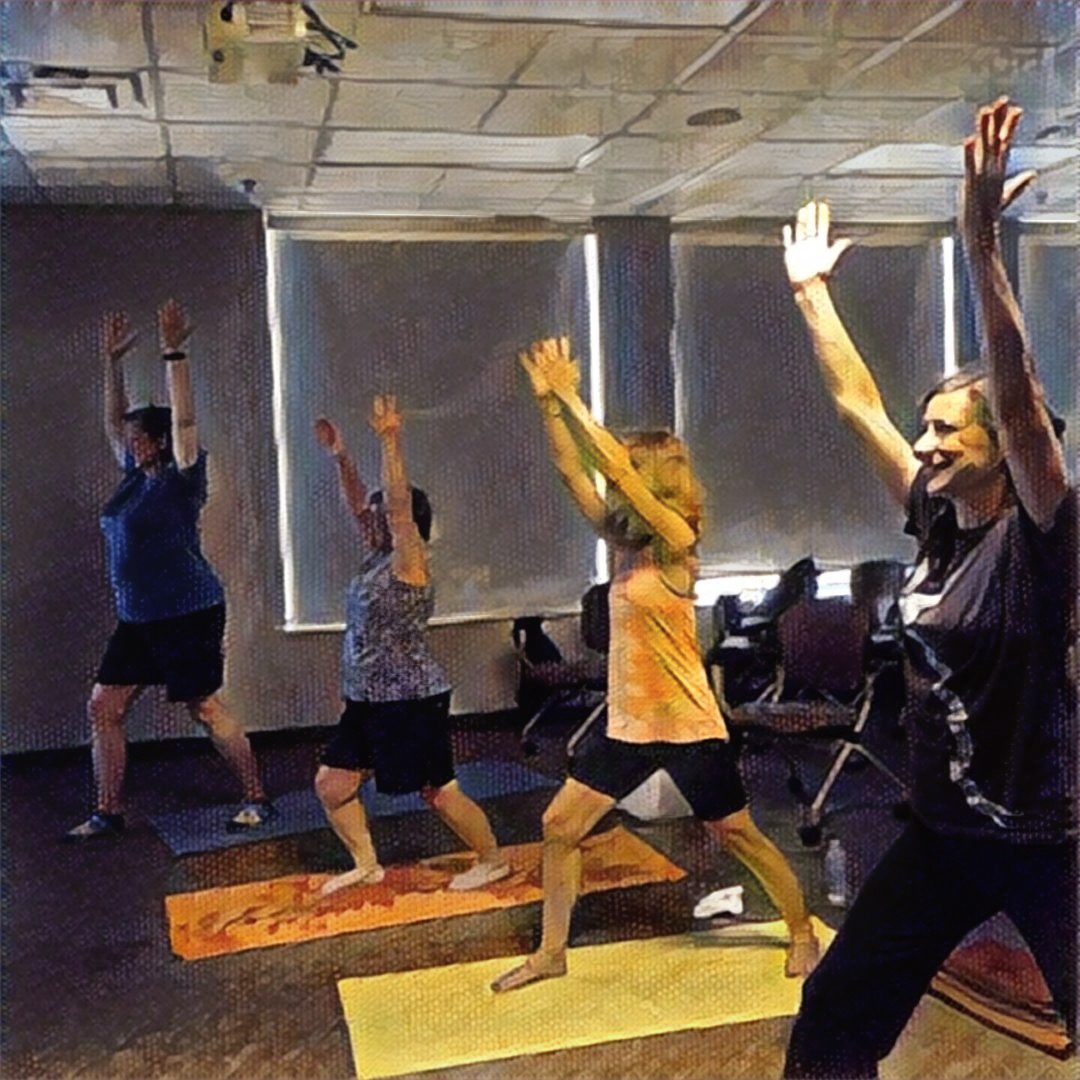
As soon as I got diagnosed with multiple sclerosis (MS), I started practicing yoga…with people who did not have MS. Yoga is not a competitive sport, and I am not a competitive person, so I’ve never wasted any energy comparing my abilities to anyone else’s. It didn’t matter if mine was the wobbliest “Tree” pose in the yoga studio. Trees can wobble, in the right wind.

At no point did I feel a need to join a special class for people with multiple sclerosis. I was doing just fine, I thought, in the yoga classes at the Fitness Center, practicing with “beginners” ranging in age from early twenties to mid-seventies. But when I saw the flyer for MS Yoga in my neurologist’s examination room, I immediately decided to join that class, too. The MS Yoga class was free. I had nothing to lose. And besides, I liked the concept. Yoga has helped me, probably in more ways than I know. Wasn’t it nice that the neurologist was offering something positive that his MS patients could do for their bodies and minds? I saw my attendance as a yes vote to the whole idea.

I might have felt a bit apprehensive the morning of the first class…I’d met people with MS before, and most of them just brought me down. The only close friend I’d made with MS up to that point had had a sparkly, positive attitude…and the progressive form of the disease. She’d recently died, hopeful to the end.

The women I met at MS Yoga that morning were charming, charismatic, joyful, and curious. We started asking each other questions, and comparing notes, before Megan, our instructor, got a word in edgewise.

Did I like the class itself? Not at first. It didn’t seem remotely like any form of yoga I’d ever encountered; starting with the fact that Megan never even mentioned breath. To me, a yoga practise without breath is like a church service without prayer; every pose starts with breath, extends with breath, transitions with breath. If you don’t have breath, you don’t have life, and you sure don’t have yoga. But what our class did have, right away, was community; we were as fascinated by each other as if were all reunited siblings, separated at birth.

Our ending “Namaste” (“the light in me greets the light in you) would not be a goodbye. There was a lunch place two stories down from our ad hoc conference room/yoga studio. We all agreed to extend the party through lunch. We called out the high performers as we prepared to leave; “You can still balance on one foot as you put on a sneaker!” And as we went down the stairs, “You can walk without a banister!” We commiserated with the one who forgot her yoga mat and had to go back for it, “I forget things, too!” And the ones who had to rush off to the Ladies Room, “I have an MS bladder, too!” We peppered each other with questions over our salads and soups, universal ones, like, “Do you have any kids/grandkids?” As well as MS related ones, like, “Do you still work?” “Do you get social security?” “Where did you get that cane?”

After subsequent yoga classes, the lunches went on, and the confessions of various disabilities grew bolder; not every symptom was found to have a match. The confessions of memory loss were by far the loneliest; what was the self, without memories?

In the meantime, I grew frustrated with the classes themselves. What was yoga, without breath? When Megan finally told me her reason for withholding breath from the practice, her explanation shocked me. Apparently she’d been taught that handicapped people should not be “burdened” with such instructions. I said, “Everybody breathes.” The assumption that people with MS couldn’t handle breathing made for an insulting pedagogy. She took note. And stopped following it. Megan invited us to breathe in class, invited us to laugh. Classes got better, week by week.

One day, Megan introduced us to the Tree pose, that pose I found so challenging in my able-bodied yoga classes. In Tree, one must balance on one leg, and rest the foot of the opposite leg somewhere on the standing leg; perhaps on the ankle, the inner calf, or as high as the inner thigh. Megan proposed that we do Tree pose in a circle, while supporting our neighbors, palm to palm. This was a method we all could achieve. Instead of forming individual wobbly trees, we formed a steady grove.

As suddenly as the class was offered to us, the class was taken away. The department of Integrative Medicine gave no explanation. The UC neurologist who was involved with this program is seeking to reprise it, to this day.

On the last meeting of the MS Yoga Group, Megan closed with this poem by the Revered Sapphire Rose:

“She Let Go

She let go. Without a thought or a word, she let go.

She let go of the fear.  She let go of the judgments.  She let go of the confluence of opinions swarming around her head.  She let go of the committee of indecision within her.  She let go of all the ‘right’ reasons. Wholly and completely, without hesitation or worry, she just let go.

She didn’t ask anyone for advice. She didn’t read a book on how to let go  She didn’t search the scriptures. She just let go.  She let go of all of the memories that held her back.  She let go of all of the anxiety that kept her from moving forward.  She let go of the planning and all of the calculations about how to do it just right.

She didn’t promise to let go. She didn’t journal about it. She didn’t write the projected date in her Day-Timer. She made no public announcement and put no ad in the paper. She didn’t check the weather report or read her daily horoscope. She just let go.

She didn’t analyze whether she should let go. She didn’t call her friends to discuss the matter. She didn’t do a five-step Spiritual Mind Treatment. She didn’t call the prayer line. She didn’t utter one word. She just let go.

No one was around when it happened. There was no applause or congratulations. No one thanked her or praised her. No one noticed a thing. Like a leaf falling from a tree, she just let go.

There was no effort. There was no struggle. It wasn’t good and it wasn’t bad. It was what it was, and it is just that.

In the space of letting go, she let it all be. A small smile came over her face. A light breeze blew through her. And the sun and the moon shone forevermore.”

We have had to let go of the yoga class, but we have stayed in touch with each other. We are no longer individual w0bbly trees, but a steady grove.


Go back

Your message has been sent

Warning
Warning
Warning
Warning

Warning.

Enter your email address to subscribe to this blog and receive notifications of new posts by email.

The Skinny on the WAhls VErses Swank Diet (WAVES Study)

Last week, I drove 475 miles to The Preventative Intervention Center at the University of Iowa to participate in Phase 1 of the WAVES (WAhls VErses Swank) MS diet study. My participation will last 36 weeks, assuming I make it through Phase 1, the Usual Diet Phase. If I do, I will be expected to visit the clinic every 12 weeks through the conclusion.

The WAVES study is open to people with relapsing/remitting multiple sclerosis (MS) who experience MS related fatigue. The purpose of the study is to compare two dietary approaches to see which diet is more successful at reducing fatigue. The hypothesis is that consuming one of the study diets will reduce MS related fatigue, improve energy and improve quality of life.

The bias of the experimenters for the Wahls diet remains unexpressed in the literature they hand out to us lab rats. (Well, the nitpicky can find bias revealed in the name WAhls contributing the first two letters to the WAVES acronym, whist the name Swank is contributes only one. I am not that nitpicky.)

On my next visit, I will be randomly assigned one of the two diets, and must then commit to following that diet exclusively. The twist: my super indulgent husband will also have to commit to following whichever diet, at least for every meal he has at home. Because this is a blind randomized study, I can’t let the administrators know which diet I’ve been assigned. This means, gentle reader, I can’t let you know either, on the very off chance that the study administrators don’t have anything better to do than check an amateur blog. (This is where I lose you, dear reader, and you suddenly remember you had meant to be curing cancer at the moment. Godspeed!)

While I can’t help but assume that the WAVES study is biased toward the Wahls Protocol, since Wahls herself designed it, I myself do not share this bias. Well…maybe a teensy bit. A very healthy, very active, once diseased Dr. Wahls does make a fine case for her diet in her TED Talk, which I watched to its completion many years ago. I am sure there is an equally compelling case for the Swank diet in the book I couldn’t bear to finish, which currently collects dust on my bedside table. (The issue of my reluctance to fully research either study will make another blog post eventually. Or a podcast.)

If I do get assigned the Wahls Protocol, I will be happy, because it is so intimidating and involved, I feel I will need the challenge of doing my due diligence as a Lab Rat to actually see it through. (In addition, I can lean on the professional assistance of the study nutritionist, who will assign me the diet and will keep this random assignment to herself.)

If I get assigned the Swank Diet, my husband, for one, will be happier, since he’s concluded (from his 14 second scan of the description) that this diet is more in line with the one we already follow. I am going to need his support, so I would be grateful for an option he finds palatable

Here are the diet descriptions, straight from the 22 page consent form:

“One diet is a low saturated fat diet that eliminates beef and pork and includes whole grains, fat free dairy, vegetables and fruits (Swank) and the other is a modified paleo diet (Wahls Elimination) that eliminates all grains, legumes (e.g., beans), eggs, dairy, and nightshade vegetables (tomatoes, potatoes, eggplant, peppers) and stresses more vegetables and meat in the diet.”

If you were assigned one of these two diets, which would you be more willing to follow for 24 weeks?

Go back

Your message has been sent

Warning
Warning
Warning
Warning

Warning.

Enter your email address to subscribe to this blog and receive notifications of new posts by email.

Wahls Elimination Diet vs Swank Diet: Which Is the More Effective Treatment for MS Related Fatigue? Ms. Lab Rat jumps into the maze.

Some Background (faithful readers can skip to paragraph 5):

As my faithful readers know, I am a machine with faulty wiring. Multiple Sclerosis has somehow managed to convince my T-cells to attack the insulation that surrounds the nerves conducting all the information my body needs to function optimally. This insulation is called myelin, and my myelin is ratty with scars. (Multiple sclerosis=many scars.)

When I got the diagnosis, I refused to accept my fate. I tried the first medication I was offered. And when that didn’t work, I tried a second. And when that didn’t work, I entered a clinical study of a new medication, one, I was told, that really made a difference. But as will happen 50% of the time with clinical studies, it turned out I was assigned to the control group. I didn’t get the new medication. I got a placebo. And I got more scars.

I not only tried new medications, I tried new doctors. (I moved around a lot, at first, so that part could not be helped.) When my fourth neurologist gave me the dour news that I was doing very badly, and could expect to do worse, and then much worse until I died, well, I switched to a cheerier doctor. Who gave me the same dire news, but with a big smile. I dumped her, too. Instead I found a brilliant researcher, Bibiana Bielekova. Researchers are always looking for better ways to do things. So am I.

Long story short, I talked Dr. Bielekova into letting me try an off-label drug that worked with the immune system, rather than fight it. Daclizumab works by boosting the population of Natural Killer Cells, which function like the good cops in the Wild West of my immune system; the Natural Killer Cells keep the rouge T-Cells, or bad cops, at bay. Daclizumab worked. The T-Cells stopped attacking my myelin. Eventually, the National Institutes of Health (NIH) funded a study of Daclizumab. I was lucky enough to join the safety arm of the study, so I was assured a constant supply of Daclizumab. In the last ten years, this medication has been so effective, the T-cells have only once managed to create a new scar. Earlier this year, the FDA apporved Daclizumab under the name Zinbryta. On the day I injected my last dose of free study medication, I was accepted into a new clinical trial.

Faithful readers, jump in here:

Finding a drug that stabilized my MS only solved half of my problem. While my T-cells have stopped chewing on the fatty myelin that insulates my nerves, the many scars created by years of insatiable gobbling still interrupt the signals of my central nervous system. I have to cope with fatigue, pain, lack of coordination and balance, and a digestive system that’s out to lunch. Oh yes, and a brain that continues to shrink. You would think, then, that a person as proactive as I am would have immediately acted when I saw a very convincing TED Talk by a smart researcher who overcame an even worse case of MS than mine. Like me, Dr. Terry Wahls took the latest greatest MS medication. And like me, her MS only got worse. Dr. Wahls soon found herself confined to a tilt-recline wheelchair. Unlike me, Dr. Wahls is a physician. She read the latest medical research about diseases in which brains shrink. She read studies in which animal brains had been protected from shrinkage using fish oil, creatine, and co-enzyme Q-10. She started taking human proportioned dosages of these substances, and started getting better. This was her first round of self-experimentation. Slowly but surely, she tweaked her diet to include and exclude certain nutrients and ultimately found herself out of the wheelchair, biking to a full day of work as a doctor, and, of course, promoting the diet that saved her. She managed to get the Multiple Sclerosis Society to chip in 1 million dollars to fund a scientific study to compare her diet with the Swank Diet, one that has been  found to help people with MS for decades. I, who was somehow too intimidated years ago to follow the Wahls Protocol, have now agreed to be part of this study, which is going to be a much more onerous and complicated option than simply buying her book and following along. How much more onerous and complicated? I’ll share the details in my next post. But strange as it is, a Lab Rat is a Lab Rat. I would rather experiment on my diet in a study as a contribution to the greater public knowledge than to simply tinker with the diet on my own.

How about you? Have you ever participated in a clincial trial? Would you?


Decisions, Decisions

Last Friday, I had a simple decision before me: ziplining or kayaking?

My friend Elaine and I had agreed to go ziplining—oh, two Octobers ago, and somehow our plan kept getting put off. We were on the verge of letting yet another bright autumn slip away with no zip. Neither of us wanted to be the first to admit that we are no longer in the market for thrill seeking, that a sedate afternoon of kayaking is now more our style; thus the question of which activity to pursue was still dangling by a text message thread as I entered my optician’s office for my annual exam.

I wasn’t all that keen on keeping the appointment—I already had a lifetime supply of contact lenses. This is how old I am: I am so old, I remember when “soft” lenses were not yet a thing; when contact lenses were suffocating brittle little plates. A ripped contact lens meant penury, for in those days one contact lens cost far more than today’s one year supply of soft “disposables.”

As the oldest of three, then four, severely myopic children in a family with little or no disposable income, I would have been astonished to learn civilization would eventually produce disposable contact lenses. To this day, I find the concept offensive. Why throw out a perfectly viable technological miracle?

We children wore our contacts until the lenses cracked, or until our prescriptions worsened, whichever came first. As such events occurred with horrific regularity, our severely myopic family of five, then six, was a winning lottery ticket for our local optician. I couldn’t help but resent our optician’s relative wealth. And feel deep personal shame every time I let the family finances down…again…while contributing to that mustachioed man’s vacation fund.

I’ve never quite outgrown that shame, or my indignation when suddenly little slips of plastic went from being worth hundreds of dollars each to being sold in 365-packs for way cheaper. There has never been an intermediate stage of cheap single serve contact lenses…except in my medicine cabinet. I still wear my contacts until they rip or until my prescription becomes obsolete. I keep reaching what I think must be the outer limits of nearsightedness—a -10 on what I assumed had to be a scale of -1 to -10—only to learn in subsequent visits to subsequent opticians that there are further negative integers.

Last Friday, I hit a new low: -13. And that wasn’t the bad news.

The bad news was that the flashing lights I’d sensed as coming from behind my left eyeball weren’t some silly commonplace symptom of my multiple sclerosis, as I’d assumed. The optician referred to those flashing lights as an “event” that signaled my retina was maybe thirty days from detaching. She then recommended I get an appointment thirty days out, though I should see her earlier, if “a dark curtain falls across your vision. Or an array of floaters.”

I made the appointment to be polite; I was already thinking of consulting a specialist. There had to be a more proactive approach.

I refused to enter “detached retina” on Google. Instead, I texted my husband about the problem, figuring he’d Google for me, and spare me the worst. He texted, Don’t stand on your head. Stay away from roller coasters.

Excellent! The zip-line vs. kayak decision was made for me! No zip-line.

This retina crisis was wonderful. Clarifying. I would put my affairs in order. Pronto.

Another decision—vote early or vote on Election Day?—resolved. I would vote first thing the next morning.

The future is…more and more problematic.

For months now, I’ve been looking forward to driving up to Iowa City to participate in an exciting study funded by the MS Society which will compare two popular diets to treat MS-related fatigue. I’ve been fascinated by the possibility that MS can be treatable through diet, but I’ve always been hesitant to go all-out. Joining the study is going to force me to be one hundred percent compliant, while also being a force for the greater good.

And while participation in the study has been reason enough for visiting Iowa City, I’ve also been planning to stick around town the following day for a ceremony to honor James Alan McPherson, a brilliant writer and compassionate teacher of mine from the Iowa Writer’s Workshop. Other writers I love and esteem and/or have read will be traveling from around the country to gather in his honor. I’ve been reading his work all week, revisiting some of the very themes I remember him bringing up in workshop, to little avail. Most of us students weren’t yet well equipped to respond. I, for one, was too young at the time, too narrowly focused. Which is why I’ve appreciated his words being frozen in time in his essays, waiting patiently for decades for me to finally grow up.

While I’ve lost my chance to ever talk to Jim again about Spartans vs. Athenians, I’m happy to say that at least I did have a chance to reconnect with him five years ago, at an Iowa Writer’s Workshop Seventy Fifth Anniversary Reunion. He had been sitting alone in a crowded room; unrecognizable in that he was thoroughly unacknowledged. I sat and talked with him a long time, comparing notes on living with chronic pain and chronic illness. When I left him, I didn’t expect he’d make it another five years; I don’t think he was expecting that, either. The ceremony for him will be a vast and profound validation. It will be something to see. I’ve wanted one of us to get to see it.

So I went to a retina specialist. While I carry that old grudge against opticians, I have all the respect in the world for ophthalmologists. I’d expected an ophthalmologist would be proactive, would have some sort of plan to prevent a “dark curtain” or “an array of floaters” from falling across my vision. Surely, a retina specialist wouldn’t keep me in suspense for thirty days.

The retina specialist saw me promptly. He took a very fancy picture of my eye. That was service. He said I should make an appointment to see him in thirty days, or to call him immediately , if  “a dark curtain falls across your vision. Or an array of floaters.”

I had to admit it. The optician wasn’t so far off.

But this guy is better. He has to be. He told me he can fix the problem. He told me that if I get to him early enough in the trauma, he can fix the problem in his office. But if I get there later? He can fix it in the OR.

I already knew from my husband’s Google foray that those OR surgeries take weeks to recover from.

It seemed to me, then, that it was a good thing I lived a mere ten minute walk from his office.

“So,” I ventured, “I like to travel. Do you think it’s a good idea to travel right now?”

img_5935
The specialist answered soundly, “Travel.”

I went ahead and made an appointment with him for thirty days out.

Yesterday, I packed my bags for a three day trip to Iowa City. It was a gray day; perfect for my light sensitive eyes. I made it seventy miles before I started seeing floaters, squiggly little lines wafting across the gray sky. I wondered, how many floaters constitute “an array?”

I still had four hundred miles to go. There was so much waiting for me at the other of this trip. People I haven’t seen in five years, in twenty years. People I’ve been eager to meet. But the only person I was thinking of was my husband. How awful it would be for him to get a phone call asking for a rescue. Or worse, a phone call from a far-away hospital.

I had to make an uncomfortable decision.

I could keep driving, keep asking myself, every few miles or so, is this an array?

Or I could turn around.

It wasn’t a difficult decision, after all.

Go back

Your message has been sent

Warning
Warning
Warning
Warning

Warning.

Enter your email address to subscribe to this blog and receive notifications of new posts by email.

Once A Lab Rat, Always a Lab Rat

The NIH study that has nurtured me since 2010 is over. The day I’ve been anticipating with measured trepidation has finally arrived. A few hours ago, I took the last of the vials of free medication from the NIH out of my refrigerator, and injected.

If the drug had not passed the FDA approval process, this would have been a very sad day. But it did pass. The fruition of the study is available commercially as Zinbryta. Dr. Z., my neurologist, has already set in motion a smooth transition for me; I’ll be the first of his MS patients to purchase Zinbryta. I won’t have to miss a dose of the drug that has given me my life back.

So today, then, marks the happy ending to my life as a Lab Rat?

Not so fast.

Today marks the closing of one chapter. And the opening of another.

This morning I received a phone call from a research assistant named Brianna. She asked me ten easy questions designed to provoke pleasant answers, such as, “Today is Tuesday, September 15, 2016” and, “Barack Obama is the President of the United States.” At the end of this quiz, I found myself qualified to be a Lab Rat in the MS Diet Study.

As any faithful reader of this blog knows, I am very interested in the role of diet in the management of MS. I’ve been intrigued by the Wahls Diet since seeing Dr. Wahl’s TED talk; I couldn’t help but be impressed that she has managed to eat her way out of a reclining wheelchair and back to full time medical practice.

This study will randomly assign me to either the Wahls Diet or the Swank Diet. As it happens, I am comfortable with both. Dr. Z. has met many people with MS leading active, healthy lives on the Swank diet. It will be a win for me either way.

I don’t have to ditch Zinbryta to participate.

Could a lab rat be any luckier?

Another fun perk of this study: I will be traveling to Iowa City, home of the Iowa Writer’s Workshop, where I got my MFA in fiction, and, come to think of it, my MS diagnosis. This Lab Rat will be traveling full circle.

I do hope you will follow Ms. Lab Rat to my next maze in Iowa City. I won’t be able to blog about which MS Diet I am assigned to, because the researchers must be blind.

I am so very grateful, above all, to my husband, who likes our current diet very much, but is willing to give an MS diet a try.

Go back

Your message has been sent

Warning
Warning
Warning
Warning

Warning.

headshot

Enter your email address to subscribe to this blog and receive notifications of new posts by email.

Saving Face

“God has given you one face, and you make yourselves another.”
William Shakespeare
Act 3, Scene 1 of Hamlet

I knew I was in trouble before I opened up my eyes this morning. I could feel that my eyelids were swollen before I attempted to wrench them apart. A trip to the mirror confirmed what my senses implied. My upper eyelids were elephantine. Worse, there were tender red patches beneath each eye. Worse still, tonight I’m scheduled to sit in front of a hundred or so paying audience members with a spotlight shining on this problematic face. Worst of all…it’s kind of my fault.
I write, “kind of,” because last night, when I applied my makeup, I hadn’t realized the potential for this consequence. I write, “my fault” because my neurologist had given me the opportunity to take an all-expense paid trip to the National Institutes of Health, (NIH) in Bethesda, Maryland, and get my rash seen by a dermatologist there. At the last minute, I’d chickened out, and had the NIH cancel my flight, because on that particular morning, my skin didn’t look so bad, nothing a little concealer couldn’t fix. I couldn’t stand the thought of flying all the way to Bethesda over a couple of little scaly patches that could be covered up with concealer. Believe it or not, I thought I was saving face. I couldn’t stand the possibility of being regarded as a hypochondriac.
Yeah, right. That hypochondriac option has been out for decades. Who did I think I was fooling?
I’m going to have to back up a bit. I’m going to have to be straight with you about a thing or two.
Starting with this: I set up this blog to share my experiences on an experimental medication for multiple sclerosis, DAC HYP. It’s only now that I notice that I’ve underplayed…as in, possibly haven’t mentioned…that I’ve experienced a side effect. That side effect is rash.
You might well ask, why not?
Here’s why not. I’ve got multiple sclerosis (MS) a horrible, and so far, incurable, degenerative neurological disease, and DAC HYP is the only medication I’ve taken—and I’ve taken plenty—that has actually served to stop the disease progression.
That’s pretty significant.
Rash? As side effects go, rash just hasn’t seemed that significant.
To put it into context, a potential side effect for a competing drug, Tysabri, is sudden death. So, yeah—rash. What of it?
I’d rather have a rash I can see than a brain lesion I can’t see. The choice to take the medication, and bear with the side effect, has been a no-brainer, at least for me. For a while there, I thought that anyone who saw things differently must just be more brain damaged than I am.
Two things have happened since I’ve started this blog that have changed the way I view the risk/benefit analysis of taking a drug that stops MS, yet causes rash.
Thing One: after years and years and years on this drug, I finally did get one—and only one—new brain lesion. And still, as far as I can tell, that’s a phenomenally good result if you compare the efficacy of this drug to that of any other MS drug out there. I’ve been told this one lesion had the good grace to show up in a “silent area.” I don’t agree that the damage was silent—I felt pretty horrible for a while there—but in truth, I’m feeling all right now.
Except for—
Thing Two: the rash has gotten worse.
Way worse.
When the rash first showed up—I believe that happened around the time the medication changed its formulation—it appeared on the inside of my hand; a nice, innocuous spot. No one was too likely to see it. And that was important to me. Some people call MS an invisible disease. I like it’s invisibility, thank you very much. MS only stays invisible if it isn’t allowed to progress.
The rash itched. I applied hydrocortisone. It went away. And then the rash reappeared, on my face of all places. A place everyone was likely to see. And that made the rash something I had to…um…face.
I managed to not face it.
I had a solution. I used a cosmetic. A simple concealer. Perhaps if I were a man, and not in the habit of putting on makeup, that move would have felt like a big deal. But I am a woman. Most of us women are all too familiar with, shall we say, putting our best face forward. (See: Hamlet.)
So yes. I wore concealer over my rash every day. Even on those days the NIH flew me out to examine me, to, you know, see if I was experiencing any side effects on DAC HYP.
Maybe we’ve been at cross-purposes. Whenever I visit the NIH, I always strive to be mistaken for a doctor instead of taken for a patient. My most treasured moments in Bethesda are the times I (almost) get away with this, like when a driver for the NIH picked me up from the hotel and asked, “Are you a patient, or…”
I treasured that “or.” I gave that driver a big tip.
The NIH culture supports these seemingly innocuous mistakes of identity. A nurse once berated herself after she’d asked me a question about my condition in an elevator. “I shouldn’t have done that. I’m not supposed to address you as a patient in front of other people.”
I’m not to be treated like a patient. I’m to be treated like a peer. One never gets too personal with one’s peers. I’ve had one neurologist actually apologize several times during an examination, for having to touch me, for asking me to disrobe. I understood she was expressing her respect for me. But that sentiment can go too far, and actually disrupt the messy process of getting down to the ugly truth.
And it’s hard to get there. For instance, you’ve been reading paragraph after paragraph about my rash, and I still haven’t mentioned I also have scaly dry patches on the inner folds of my arms and my legs. These patches itch. But I tend to forget to mention them, not only to you, but to my neurologist. Why? Because these itchy patches are not visible to others, at least not in the winter months. I can bear almost any amount of discomfort. I just can’t bear exposure.
Which brings me to the prospect of going onstage with a rash in front of about 100 people.
I’d had other plans for this evening’s appearance. I’d planned to get a professional make-up job. I’d planned to get an elaborate up-do. I’d planned to look fabulous, like I did on opening night, just a few hours after I made that cancellation.
Life doesn’t always go as planned
When I’d cancelled my flight to the NIH and my appointment with the NIH dermatologist, my neurologist had suggested I quit wearing make-up. After opening night, I complied. As of last night, my face was repaired, just in time, I thought, for me to take the stage again. Thinking the problem was over, I’d applied a little makeup before going to a concert. We know how that turned out.
This morning, I cancelled my make-up session. I didn’t want to make my elephant face any worse. I did not cancel my up-do.
And then I went to yoga. I’m so glad that I did.
Our teacher, Sharon, shared a passage from a book in which yoga instructor Sianna Sherman answers the question, What’s the best advice you’ve ever gotten?
Sianna answers, “Inner body bright,” a phrase she’d picked up from her teacher, John Friend. Sianna explains that this phrase is “his way of saying ‘It doesn’t matter what’s happening on the outside. No matter how fierce and intense and up against ourselves we feel, if we tap into that place—the place that yoga guides and invites each one of us to—we’ll find that our essence is bright and that our inner freedom is fully present.’ Often, it’s our outer freedom that’s compromised by own mind. We say: ‘Oh I’m not free’ or “I’m a victim, I’m not empowered. Or, ‘This happened to me…’ And then we start to close down. And that’s easy to do, but if we go inside and wait a minute, there’s this inner freedom that’s never compromised; there’s this inner light that’s always true. So you say to yourself, ‘Inner body bright, let me melt the outer body, melt all the crazy stuff that’s happening into the fire of my heart, into that inner light, and then I’m going to stand tall in this light and keep going, no matter what.”
As it happened, that message was exactly what I needed to hear to muster the courage to get onstage with a rash, and without the makeup. When I sit in the spotlight, I somehow doubt I’ll be whispering to myself, “inner body bright.” But I did get the message there’s more to me than meets the eye.
I have lived a long time. I have sported many appearances. I have been a cute little girl, a wince worthy adolescent. I’ve been a woman in a wheelchair. Last week, just before my opening night performance, when I was the lady with the fabulous updo, the owner of an upscale restaurant rushed up to my beautiful family, and asked, “Where do you come from?” in awestruck tones, as though he expected us to answer, “We have descended from Mount Olympus.” That night, it didn’t feel like a challenge to take the stage.
Tonight I’ll have to give the audience some credit. I’ve cancelled my up-do. I won’t apply concealer. I’ll see if I can summon up enough inner beauty to outshine the rash. (The swollen eyelids had calmed back down.) I am, after all, performing for trueTheatre. The audience expects me to be vulnerable. What better occassion to take that risk?

Rerun: The Cold Keeps the Riff Raff Out

I probably should not admit this; under certain circumstances, I do give up. I give up on big things. Things I love. Things that define me to myself. A few months ago, I gave up on swimming at the YMCA.

Swimming is one of the few cardio-vascular exercises still open to me; as I explained in an earlier entry, I have to avoid raising my body temperature. Any time I get too hot, my multiple sclerosis symptoms rear their ugly heads. It gets kind of tricky to keep fit while also keeping cool. Exercise isn’t about keeping cool; exercise is about burning calories. “Feel the burn;” that’s the mantra. Problem is, when I feel the burn, it means I’m about to go down.

I’ve found all sorts of ways to work around this hitch. I can use the weight machines at the gym; I simply lift the lightest increments. I walk over to the water fountain after each machine, and take a drink to avoid overheating. Then I go on to the next machine; perform my repetitions. Rinse. Repeat. My system works. I do get toned. I don’t get overheated. There is just one flaw. I do get bored.

I am not about getting bored. I am all about joy. Did I say exercise is about burning calories? That’s a boring way to look at it. Exercise, at its best, is about celebrating the body, at its best. Exercise is an act of joy.

For me, the most joyous form of exercise is swimming. My husband calls me a mermaid, because even on those days when I cannot walk, when I cannot put one foot in front of the other, I can still swim. Being in the water levels the playing field. The water exempts me from negotiating my balance. It exempts me from gravity. I know why the dolphin grins.

After all this waxing rhapsodic over swimming, you would think that nothing would stand in the way of me and a swimming pool. Let me introduce you to the women of the YMCA locker room. Gentlemen, avert your eyes.

My first impediment was an aging Southern Belle, who introduced herself by stating, “You’re not from around here, are you.” She asked me for my name, and my birthplace. I told her I was born in the Bronx.

The Southern Belle stiffened. I added, I thought helpfully, “Bronx, New York.”

“Oh, I guess that’s all right.”

A few visits later, The Southern Belle grilled me again about my birthplace. The first time she’d asked, she’d been poolside, looming over me as I backstroked. The second time, I had just stepped out of the shower in the locker room. The Southern Belle apparently felt very comfortable in the locker room. As she was asking me about my birthplace, she was languidly applying her hairdryer to her billowy private parts. Startled, I averted my eyes. I towel dried and dressed as quickly as possible. The hairdryer droned on. I could not help but notice as I passed The Southern Belle on my way out that she was still aiming her hairdryer where the wind should not blow. I checked the clock on the wall. Eleven thirty.

Let me tell you something about the daytime YMCA regulars. They are creatures of habit. I am not, and can never be, a creature of habit. I am not, and can never be, a “regular.” I am a creature with brain shrinkage. I could not be tethered to a schedule, even if I wanted one. When I plan, MS laughs.

This YMCA regular was getting in my way. I figured she couldn’t possibly linger at the YMCA all day. The Southern Belle had to eat. By the looks of her, The Southern Belle had to eat quite a lot. She would likely take a break for lunch. I would no longer go to the Y in the morning. I would go instead at noon.

This plan was brilliant. I encountered The Southern Belle on her way out. We were both fully dressed. She may not have recognized me; she didn’t ask me where I was born. I changed and showered unmolested by her questions; and arrived at the pool—with all the other lunchtime swimmers.

I waited for a free lane. One swimmer was gracious enough to offer to share his lane. I accepted.

I like to lose myself when I swim; I’m pretty sure I’m not unique in that regard. I knew what he was giving up. I tried my best to be a good neighbor; to keep to one side, to keep a pool length between us. All that neighborliness was exhausting. The man was a shark. He never stopped moving. I often outlast fast swimmers. I figured, if I just held out, I’d eventually have the lane to myself. Then I noticed the waiting swimmers still poolside. Not a chance.

Maybe going to the YMCA at noon was not such a brilliant idea, after all. I remained undeterred. I could always go in the early afternoons.

Little did I know I would encounter an even more terrifying locker room adversary; an adversary who could get into my head. I feel almost guilty introducing her to you, because she’ll get into your head, too.

But maybe she needs no introduction; chances are, you already know a version of her. Perhaps you are a version of her. She is The Suburban Soccer Mom. All she does is judge. And judge. And judge.

Oh yes, and one other thing; The Suburban Soccer Mom never shuts up.

My first early afternoon swim went…swimmingly. I’d had a lane to myself. I could shut out awareness of all the other swimmers, but better still, I could shut out all my own thoughts. Swimming is my moving meditation. My mantra is simple…I count as I stroke. One. Two. Three. Breathe.

I headed to the locker room showers, dripping and peaceful. And then I heard a strident female voice.

“He’s says the kids should be there to have fun. I’m sorry, but if my daughter were winning a game every once in a while she’d have a lot more fun. Correct me if I’m wrong. Is there something not-fun about winning? Isn’t winning the point? Am I wrong, here? Am I wrong?”

A second, softer voice responded eagerly; a voice so soft I couldn’t hear a pandering word.

I stepped in a shower and turned on the water, hoping to drown The Suburban Soccer Mom out. I tried to regain the calm I’d felt after forty-five minutes of laps, of forming no words in my head besides “one, two, three.” I lingered in the shower a bit longer than usual, giving the Suburban Soccer Mom ample opportunity to exhaust her case against her daughter’s fun-loving/fun-destroying soccer coach.

As it happened, by the time I was done with my shower, The Suburban Soccer Mom was done lambasting her daughter’s soccer coach. She’d moved on to lambasting her father-in-law.

“He expects me to feel sorry for him because he just had back surgery. Why should I? It’s his own damn fault he needed the surgery. He’s too damn fat. His spine couldn’t take it. No surprise there. He should have gone on a diet. He should have gotten off his fat ass and exercised. Instead he runs to a doctor. You want to know the real problem with health care costs in this country? People are too damn lazy. They’re too damn lazy and they’re too damn fat. They overeat, and then they transfer the burden to the rest of us.”

I had to pass The Suburban Soccer Mom on my way to my locker. I didn’t give her glance. I try to avoid looking directly at the other naked women, with the presumption they might extend the same courtesy to me. Even though I didn’t look at The Suburban Soccer Mom directly, there are things I can tell you for certain about her appearance. The Suburban Soccer Mom is blonde and trim, though perhaps no more trim than I am. I can also assure you she must appear perfectly, unassailably normal. She couldn’t possibly tolerate herself otherwise.

I could not help but look directly at The Suburban Soccer Mom soft-voiced companion; she was cowering in front of my locker. The soft-voiced companion was soft-bodied. Her eyes bulged out in terror at the sound of the word, fat.

Once again, I found myself changing into dry clothes as quickly as possible to make a speedy exit from the YMCA locker room. I pitied the The Suburban Soccer Mom for her malady; an unrelenting/unremitting chronic illness that was causing her to assume she is surrounded by inferiors. If only she’d leave off judging everyone, she could be a happier person. If only she was more like…me.

On subsequent visits I heard subsequent rants. When The Suburban Soccer Mom was in a good mood, she’d alternate her judgments of other people’s failings with reports of her own successes; the laps she’d swum, the triathlons she’d won. According to The Suburban Soccer Mom, the world would be a much better place if we would all be more…like her.

And that’s how I ran afoul of The Suburban Soccer Mom. One afternoon she happened to notice that I am not at all like her.

That particular afternoon, I was fighting against fatigue. Fatigue is one of the toughest elements to deal with in MS. It feels like a personal failure. The Suburban Soccer Mom in me told me to drive to the YMCA and do my laps, though The Henry’s Mom in me thought I should save my energy so I’d still have enough vigor to pick my son up from school, to snack with him, to talk with him, to walk the dog with him, and after all that, to make the family dinner. I compromised. I decided to still swim laps, but only for fifteen minutes.

As I stashed my street clothes in the locker room, I heard The Suburban Soccer Mom announcing to the assembled that she and her daughter would be going out for a jog. I happened to return from my fifteen-minute lap swim just as The Suburban Soccer Mom was announcing to those assembled that her daughter had just texted to cancel their jog. Oh, Sububran Soccer Mom’s daughter, wherever you are, I took the bullet for you that time. Your mother looked up from her cell phone, and found a target in me .

“Well, that was the shortest swim I’ve ever heard of.”

That was it. That’s all The Suburban Soccer Mom said. Yet I didn’t go back to the YMCA for two months. The next time I felt fatigue, I stayed home. And so on, for almost three months.

I shouldn’t bother to spend any more energy dissecting what is wrong with The Suburban Soccer Mom. I ought to figure out what the heck is wrong with me. I gave up something I loved to avoid someone I hated. Maybe I ought to do a little less hating. Maybe the prescription I’ve been writing for The Suburban Soccer Mom is prescription I ought be writing for myself.

I’ll have you know that on Friday I did return to the YMCA. There was a notice posted on the front door, regretfully announcing that though the lifeguard was on duty, the pool heater was broken.

Perfect. I learned a folk saying back in the days when I lived with the good, decent people of Minnesota. The cold keeps the riff-raff out. Sure enough, the pool was empty. I could swim in any lane that I pleased, for as long or as short a time as I pleased. Better yet, the locker room was empty, too.

I’ve got to go. The pool is only open another hour. I’ve got to get in my fifteen minutes of laps.

author’s note: On the drive home from a cold, solitary swim, I heard this thoughtful discussion about judging the judger on NPR. Listen and learn: http://www.npr.org/2011/01/10/132809627/concrete-ways-to-live-a-compassionate-life

For my review of “12 Steps to a Compassionate Life,” the book under discussion on NPR that day, connect to Goodreads http://www.goodreads.com/review/show/144053847


Enter your email address to subscribe to this blog and receive notifications of new posts by email.

IMG_3573